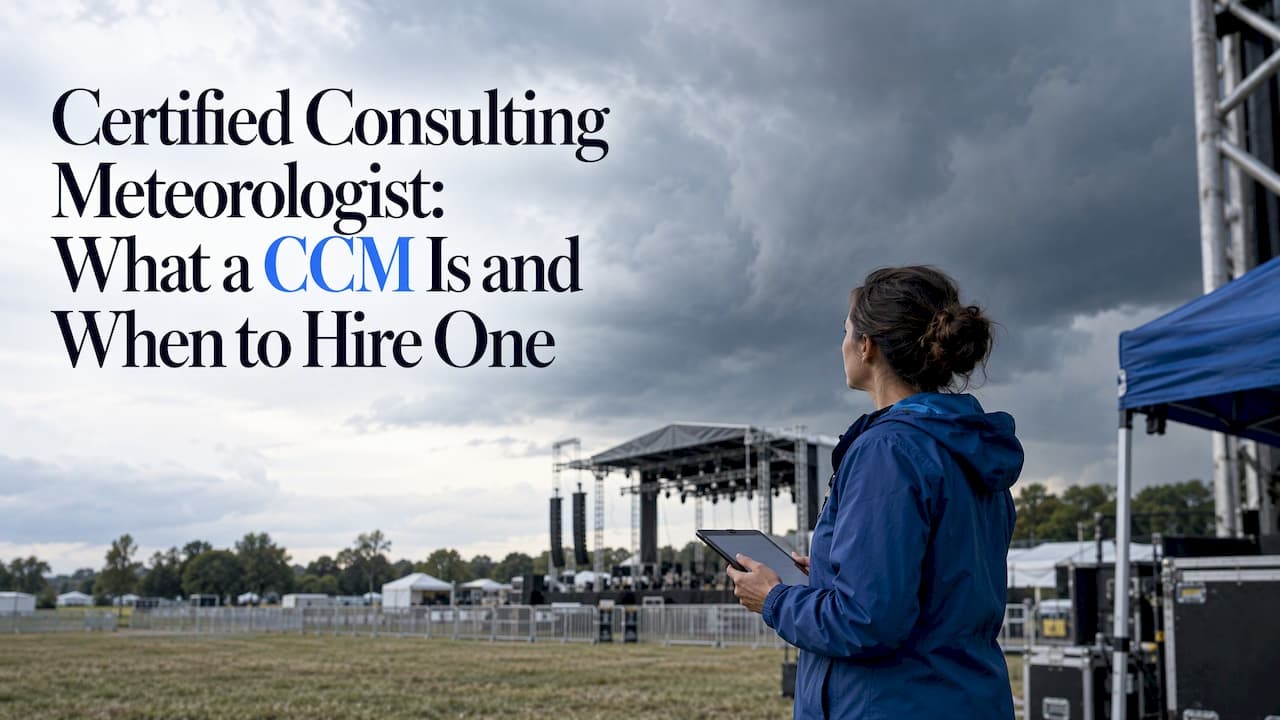
A certified consulting meteorologist (CCM) is a meteorologist who has earned the American Meteorological Society's professional designation for people who provide weather research and services to clients. The credential rests on education, years of professional work, recommendations from peers and a two-part examination. You hire one when a decision, a claim or a courtroom needs weather analysis that goes beyond a raw forecast or a data printout: an outdoor event, an insurance loss, a lawsuit, a logistics plan or a climate-risk review.
This guide explains what the designation certifies, what it takes to earn and keep it, what a CCM actually produces for a client, and how to judge fit before you commission work.
TL;DR
- A CCM is an AMS-certified meteorologist who has met education, experience, peer-recommendation and examination requirements, and who must keep earning professional development points.
- Applicants need five years of professional-level work, three associate recommendations, a written exam with a consulting essay and an oral board exam.
- Clients use CCMs for tailored event forecasts, on-site support, forensic weather reports, expert witness testimony and weather-risk studies.
- Match the meteorologist's specialty and case experience to your question, not only the letters after the name.
- We offer same-day analysis from certified consulting meteorologists; see our services.
Table of Contents
- What a Certified Consulting Meteorologist Is
- What It Takes to Earn the CCM
- How CCMs Keep the Credential Current
- What a CCM Does for Clients
- How to Choose a Consulting Meteorologist
- Our Perspective
- Work With Our Meteorologists
- FAQ
- Sources
What a Certified Consulting Meteorologist Is
The American Meteorological Society (AMS) describes the CCM as a designation showing a broad background in meteorology, detailed knowledge in a specialization, exemplary character and devotion to high professional standards. The same page notes that AMS certifications have been the nationally recognized standard in meteorological certification since 1957.
Two parts of that description matter to a buyer. The first is breadth: a CCM has to show command of the whole science, not one narrow product. The second is a specialization: severe storms, coastal and marine weather, hydrology, air quality, winter weather and many other areas each need different expertise, so a CCM's depth tends to sit in a defined field.
The word "consulting" is also deliberate. The designation is aimed at meteorologists who work for clients, which means translating atmospheric science into something a planner, an adjuster or a jury can use. That is a different skill from reading a forecast on air.
What It Takes to Earn the CCM
The AMS publishes its requirements openly. Here is how they break down.
Education and experience
An applicant needs a qualifying degree or 20 credit hours of meteorology, including 12 core credits with at least two credits in four of five core areas. On top of that comes five years of professional-level work. A postgraduate degree below a doctorate can substitute for one year, and a doctorate in meteorology for up to two years.
Recommendations and examinations
The process includes an application, recommendations from three associates, a written exam and an oral board examination. The written exam has 15 questions plus a consulting essay. Eight questions are mandatory, seven are chosen by the candidate from a pool of 10, and the consulting essay presents a scenario. The AMS suggests completing it within 90 days.

The application fee is $330 for AMS members and $660 for non-members, according to the AMS program page.
Who judges the candidates
Evaluation is handled by the Board of Certified Consulting Meteorologists, a standing AMS committee. A 1994 AMS Bulletin article describes it as seven certified members appointed by the Council. It also explains that board members must step aside from evaluating a candidate when they have a conflict of interest, such as being a competitor or business associate. The point of that rule is fairness: a candidate is judged by peers, but not by peers with a stake in the outcome.
How CCMs Keep the Credential Current
The designation is not a one-time exam. CCMs maintain it through a 28-point professional development requirement every five years. Qualifying activities include attending conferences, authoring peer-reviewed papers and mentoring students.
The AMS has long framed the program as a way to strengthen applied meteorology as a profession. In the same 1994 article, certification is presented as an incentive for professional growth beyond academic training. For a client, the practical meaning is that a current CCM is expected to stay up to date on methods, tools and research, not coast on a degree earned decades ago.
What a CCM Does for Clients
The designation is the entry ticket. The value to you is the work product. Here is what that looks like across the main use cases.
| Need | What a consulting meteorologist delivers | Typical client |
|---|---|---|
| Event weather risk | Site-specific forecast, decision thresholds, updates as the event approaches | Festival, race, wedding, sports and concert organizers |
| On-site support | A meteorologist at the venue advising on holds, delays and evacuations | Large outdoor events, construction and logistics operations |
| Forensic weather report | Reconstruction of what the weather was at a place and time, with data and analysis | Insurance carriers, adjusters, attorneys |
| Expert witness testimony | Opinions explained in deposition or court, based on the report | Law firms, plaintiffs and defendants |
| Risk mitigation and adaptation | Analysis of extreme-weather exposure and planning recommendations | Businesses, facilities, supply chains |
| Emergency management support | Weather guidance feeding emergency plans and activation triggers | Emergency management agencies |
Event forecasting and on-site support
A public forecast covers a broad area and a general audience. An event needs an answer to a narrower question: will lightning be within striking distance of the grounds at 4 p.m., and when should the stage be cleared? A consulting meteorologist works backward from your decision points. You agree on what weather matters (wind on a tent, heat on a crowd, rain on a field, lightning on everything) and the meteorologist tells you how likely each is, when, and what to do.
Having that person on site changes the dynamic further. Instead of refreshing a phone, the operations lead can ask a human being who has watched the radar and the sky all day. Our own event forecasting and on-site support are described on our services page.
Forensic weather reports for insurance and legal matters
When a claim depends on what the weather did, you need more than a number from the nearest airport. A forensic report reconstructs conditions at a specific location and time, explains which data sources were used and why, and gives an opinion that can be defended.
Official records are often the backbone. NOAA's National Centers for Environmental Information certifies archived weather records to meet authentication requirements for evidence in court, with products such as Local Climatological Data and Global Historical Climatology Network Daily available for certified ordering. A consulting meteorologist knows which of those records is relevant, how far the observing station was from the loss site, and what radar, satellite and model data add to fill the gap.
That last step is where interpretation matters. A certified record tells a court that a number is authentic. A meteorological expert report explains what that number means for the property at issue.
Expert witness testimony
A report becomes testimony when the case goes to deposition or trial. The meteorologist has to explain the science in plain language, hold up under cross-examination and stay within what the data supports.
Admissibility standards differ by jurisdiction, so your attorney decides how they apply. As an illustration, guidance for civil expert evidence in England and Wales says the court considers whether the witness has the necessary knowledge and experience, is impartial, and whether the evidence will assist the court. The same guidance tells advocates to satisfy themselves that an expert has the up-to-date experience and knowledge to be credible and withstand scrutiny, whatever designation the expert holds. In the US, ask the retaining attorney which standard applies in your court, then choose a meteorologist whose background answers it directly.
A CCM designation is one strong, verifiable piece of that background. Case history, specialty and communication skill complete it.
Risk mitigation and emergency planning
Businesses and agencies use the same expertise before anything goes wrong. A risk review looks at how often damaging wind, flooding, heat, ice or lightning has affected your locations, what thresholds hurt your operations and where a change in practice would pay off. For emergency management, the output feeds plans: which forecast conditions trigger which actions, and who gets the call.
How to Choose a Consulting Meteorologist
The letters CCM tell you the person has been vetted by peers on knowledge and professional standards. Use these questions to confirm the fit for your specific job.
- Is the specialty right? Ask what weather problems the meteorologist works on most. Hurricane storm surge, winter roads, convective storms and heat stress are different disciplines.
- What will you receive, and by when? Get the deliverable in writing: a forecast briefing, a written report, a call, an on-site presence. For time-sensitive events and claims, ask about turnaround.
- Can you reach the person directly? Weather changes by the hour. Direct access to the meteorologist matters more on event day than a polished brochure.
- For legal work, what is the case experience? Ask about prior reports and testimony in matters like yours, and share the legal standard with them early.
- Is the scope clear? Fee-based consulting is typically scoped per engagement or project. Agree on what the fee covers, including revisions and any testimony time.
Also confirm the credential directly. The AMS maintains a public directory of certified consulting meteorologists, so you can verify status before signing.
Our Perspective
Most weather problems reach us as decisions, not as questions about the atmosphere. An organizer needs to know whether to hold the gates open. An adjuster needs to know whether a storm of a certain strength really crossed a roof on a certain afternoon. A lawyer needs an opinion that will survive a deposition. In every case, the raw data is available to anyone. What clients lack is someone who can say what it means for them and stand behind it.
That is why we built our work around certified consulting meteorologists and direct access to them. Our approach is designed to deliver rapid, detailed analysis that goes beyond raw data, with same-day turnaround and services customized to the engagement. A forecast for a festival, a forensic report for a claim and an emergency-plan input for an agency share one discipline: begin with the decision, then build the weather analysis that serves it.
If you are weighing who to call, we would encourage you to bring the question you actually need answered. The right meteorologist will shape the work around it.
the author
Work With Our Meteorologists
We provide event forecasting, on-site meteorology support, forensic reports, expert witness testimony, risk mitigation reports and emergency management weather consulting. Our certified consulting meteorologists offer same-day analysis and customizable scopes, and you work directly with the expert behind the analysis. Fees are set per engagement, so tell us what you need and we will scope it with you. Start on our services page, or learn more about our AMS credentials and background.

For claims and case work, see how our forensic weather reports are put together.
FAQ
How do I become a certified consulting meteorologist?
You apply to the AMS with a qualifying degree or equivalent meteorology credit hours, plus five years of professional-level work. You also need three associate recommendations, a written exam with a consulting essay and an oral board exam. The application fee is $330 for AMS members and $660 for non-members, per the AMS program page.
Is a CCM the same as a broadcast meteorologist?
No. The AMS runs separate certification programs, and the CCM is the one aimed at meteorologists who provide research and services to a wide variety of clients. Broadcast meteorologists communicate forecasts to the public, while consulting meteorologists work on client-specific decisions, reports and testimony.
What is a meteorological expert report?
It is a written analysis of weather conditions at a specific place and time, prepared for a legal, insurance or business purpose. It documents the data used, the method and the conclusions. It can be supported by certified records such as those NOAA NCEI authenticates for court use.
How do CCMs stay current?
They must complete a 28-point professional development requirement every five years. Qualifying activities include attending conferences, writing peer-reviewed papers and mentoring students, according to the AMS.
Can I get a same-day analysis?
Yes, same-day analysis is a core part of how we work for event, claim and operational questions. Contact us through our services page with your location, date and decision points so we can scope the engagement.
Sources
- Certified Consulting Meteorologist Program (CCM), American Meteorological Society
- Bulletin of the American Meteorological Society, 1994, on the CCM board and program
- Guidance on the preparation, admission and examination of expert evidence
- Data Certification, NOAA National Centers for Environmental Information