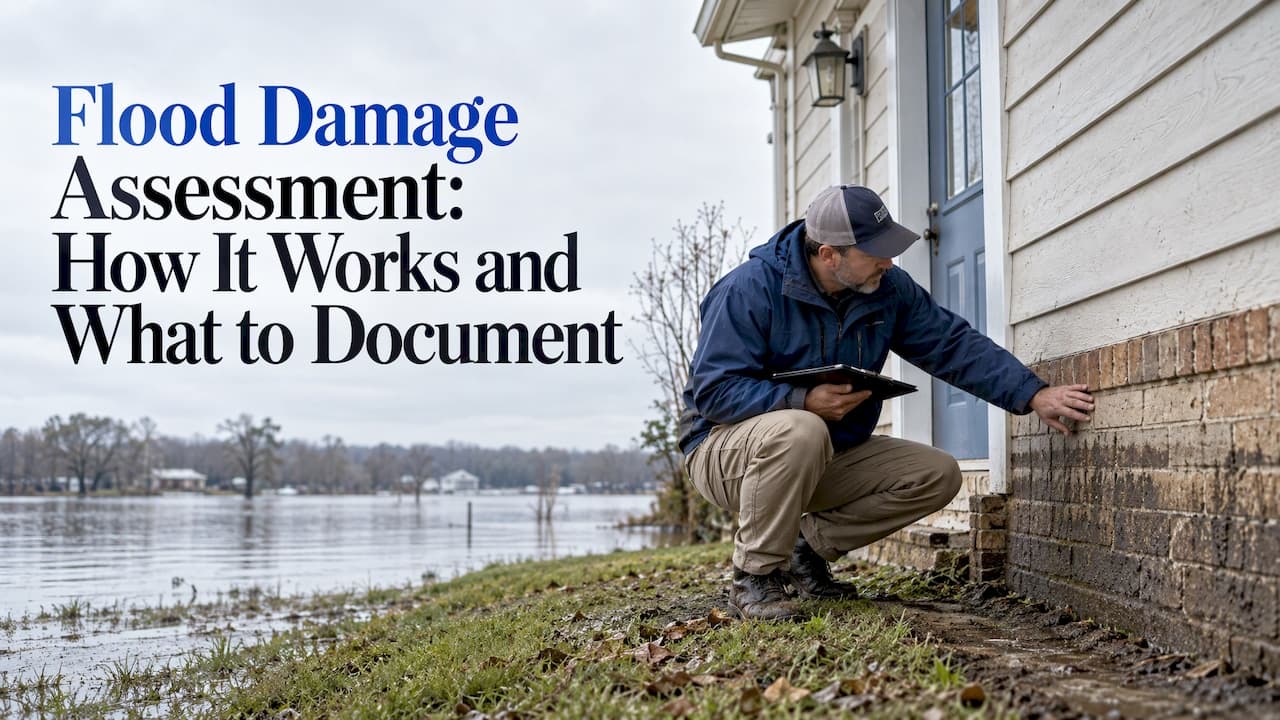
A flood damage assessment is a systematic evaluation of what a flood destroyed or impaired, and what that damage is worth. It covers buildings, contents, infrastructure and lost economic activity. It usually ends in a dollar figure that supports a repair plan, an insurance claim, a legal case or a disaster declaration. This guide explains how assessors classify damage, which factors drive the cost, what to document in the first days, and when a weather analysis can settle questions the damage alone cannot.
TL;DR
- Flood damage assessment sorts losses into tangible (given a dollar value) and intangible, and splits tangible losses into direct and indirect.
- Depth is the main cost driver, but velocity, duration, building type and usable floor area also change the number.
- Document the waterline, photos and video from several angles, appliance serial numbers, receipts and material samples before you clean up.
- Assessment is not the same as flood hazard or flood risk assessment: it measures harm that has happened, not conditions that could occur.
- When a claim or lawsuit turns on how much rain fell, when, and how fast water rose, a forensic weather report gives the file an expert, dated record.
Table of Contents
- What a flood damage assessment covers
- Types of flood damage: tangible, intangible, direct, indirect
- How damage is measured and costed
- What drives the cost of flood damage
- What to document during an inspection
- Flood damage assessment vs. flood hazard and flood risk assessment
- Insurance, disaster response and the weather record
- Perspective: why the weather belongs in the assessment
- When to bring in a consulting meteorologist
- How we can help
- A practical order of operations after a flood
- FAQ
- Sources
What a flood damage assessment covers
The Federal Flood Damage Estimation Guidelines published by Natural Resources Canada describe flood damage estimation as quantifying tangible damages. These include direct damage to public infrastructure and private property, and indirect impacts such as reduced economic activity. The results can feed flood management decisions aimed at reducing future damage.
In practice, an assessment answers four questions:
- What was damaged: structure, finishes, mechanical systems, contents, vehicles, roads, crops, inventory.
- How badly: from superficial water contact to a total loss.
- What it costs to repair or replace, and what part is recoverable.
- What caused the loss, and when it started.
The fourth question is the one people skip. For a homeowner it can look obvious. For an insurer, a contractor or a court, it is often the point of dispute.
Who uses the results
Homeowners and businesses use an assessment to support a claim and scope repairs. Insurers and adjusters use it to confirm coverage and amount. Local and state emergency managers use it to judge event severity and decide whether local resources are enough. Attorneys use it when liability, drainage or timing is contested.
Types of flood damage: tangible, intangible, direct, indirect
The Canadian guidelines divide flood damage broadly into tangible and intangible categories. Tangible damage can be assigned a dollar value. Intangible damage, such as emotional stress, illness or loss of life, cannot. Tangible damage is then split:
| Class | What it means | Examples |
|---|---|---|
| Direct tangible | Immediately attributable to floodwater contact | Ruined drywall, flooring, furnace, appliances, damaged roads |
| Indirect tangible | Results from the direct impacts | Business interruption, lost rent, extra living costs, traffic disruption |
| Intangible | No market price | Stress, illness, loss of life, loss of keepsakes' sentimental value |
Most insurance claims concentrate on direct tangible loss, with business interruption added for commercial policies. Public agencies must look at all of it.
How damage is measured and costed
Stage-damage curves
The same guidelines describe stage-damage curves as the most common, internationally accepted method for estimating direct tangible damage to buildings at urban scale. A curve relates flood depth to economic loss for a type of building. Enter a depth, read off an expected percentage or dollar loss. It is a screening and planning tool, so an on-site inspection still decides the actual repair scope of a given property.

The four damage levels used in the field
Emergency managers in the US commonly classify structures using the FEMA matrix. The Indiana Preliminary Damage Assessment Field Guide lists four categories: Affected, Minor, Major and Destroyed. Local assessments help officials determine event severity, count impacted homes and businesses, and decide whether local resources are sufficient. A claim file uses finer detail, but understanding these categories helps you read official reports about your area.
Crops and farm losses
Agricultural assessments work differently. They include crop, soil, livestock and equipment losses, and according to the Natural Resources Canada guidelines they depend primarily on the timing and duration of flooding rather than on depth alone. A shallow flood at the wrong point in the growing season can cost more than a deeper one after harvest. That makes the weather record, not only the waterline, part of the evidence.

What drives the cost of flood damage
The federal guidelines identify water depth, flow velocity, inundation duration, building characteristics and usable floor-space area as the factors that influence flood losses. Here is what each means for a real property.
- Depth. Even an inch inside a building reaches flooring, baseboards and insulation. Each additional foot reaches outlets, cabinetry, then mechanical systems.
- Velocity. Moving water carries debris and can shift or break walls, foundations and decks. Still water mostly soaks.
- Duration. Materials that dry in a day may be salvageable. After several days, drywall, insulation and wood subfloors often are not, and mold becomes a factor.
- Building characteristics. Construction type, number of stories, basement use and finish level all change the repair bill.
- Floor area. More usable area flooded means more material to remove and replace.
One academic study, Paprotny and colleagues (2020), argues that building size and floor area are inversely correlated with relative flood losses. Larger, multistory buildings often have a lower percentage of their total assets exposed to floodwater. The dollar loss may still be large, but the share of the building's value lost tends to be smaller.
What to document during an inspection
The NFIP Claims Manual (March 2025 edition) sets out the evidence that supports a flood claim. Gather it before you discard anything, and only when it is safe to enter the building. Turn off power and follow local officials' guidance first.
- The waterline. Record the debris line that marks the maximum flood height, inside and outside, with a tape measure in the frame.
- Photos and video. Capture structural damage and contents from multiple angles, wide shots first, then close-ups.
- Serial numbers. Record them for appliances and electronics before they are hauled away.
- Samples. Keep small samples of damaged flooring or wall materials.
- Receipts. Keep receipts for repairs and cleanup. The manual treats samples and receipts as evidence to prove losses and support adjustments.
- A dated log. Write down when water arrived, when it peaked and when it receded, as best you know.
That last item matters more than most people expect. Photos prove what the damage looks like. A timeline helps establish what caused it.
Flood damage assessment vs. flood hazard and flood risk assessment
The three terms get mixed up, and they answer different questions.
- Flood hazard assessment looks at the physical event: depth, speed, extent and timing of floods that occur or could occur in a place.
- Flood risk assessment combines that hazard with exposure and vulnerability: what is in the path and how easily it is harmed. The American Geosciences Institute explains why flood risk is not the same as flood hazard: hazard plus exposure plus vulnerability equals risk.
- Flood damage assessment measures harm after a flood has happened, or estimates the harm a modeled flood would cause.
They connect. Hazard and risk work tells you what to expect. Damage assessment tells you what it cost. Modeled damage estimates also guide mitigation spending: if you can estimate annual expected losses, you can judge whether elevating equipment or protecting a facility pays off.
Insurance, disaster response and the weather record
Damage assessment supports both insurance recovery and public response. A Society of Actuaries research report on modeling, measuring and pricing flood risk notes that flood insurance contributes to recovery preparedness and can affect all four pillars of flood risk management.
A claim can still stall on questions a damage inspection cannot answer:
- Was this surface runoff, a river overflow or a plumbing failure?
- Did the rainfall exceed what a drainage system should handle?
- When did the water arrive relative to a policy period, a warning or a work stoppage?
- Was a construction delay caused by weather that was actually unusual for the site?
These are meteorological questions. Rainfall totals, radar-estimated intensity, river and tide conditions, and wind and surge records exist for the date and location in question. Interpreting them correctly is a specialist task.
Perspective: why the weather belongs in the assessment
Most flood files we see are strong on damage and thin on cause. The photos are clear, the repair estimate is itemized, and then someone asks how much rain fell at that address, over what hours, and whether it was an extreme event. Raw station data rarely answers that on its own.
This is where a certified consulting meteorologist changes the file. We go beyond raw data to explain what the atmosphere did, what it means for the specific property or operation, and how it lines up with the timeline of loss. Our forensic reports are written for insurance and legal use, and our team also provides expert witness testimony when a dispute goes to court.
Speed matters too. Evidence ages, cleanup erases waterlines, and parties form positions early. That is why we offer same-day analysis and customizable services, with direct access to the meteorologist who is doing the work.
the author
When to bring in a consulting meteorologist
You do not need one for every flood. A straightforward homeowner claim with clear coverage usually runs on the adjuster's inspection and your documentation. Consider a meteorological analysis when:
- The amount in dispute is large, or several parties may be responsible.
- The cause is contested: rainfall, overflow, surge, snowmelt or an infrastructure failure.
- A policy period, deductible or exclusion depends on the date or nature of the event.
- Attorneys expect testimony about the storm's severity or whether it was foreseeable.
- A business needs to show that weather, not its own planning, caused delay or interruption.
- An agency or company wants to plan ahead, with emergency weather plans or a climate risk review.
How we can help
WeatherPrep, LLC provides professional meteorological consulting through certified consulting meteorologists. For flood matters, the relevant services are forensic weather reports for legal and insurance needs, expert witness testimony, and rapid turnaround analysis. For organizations that want to prepare rather than react, we also offer risk mitigation reports and emergency management weather consulting. You can see the full list on our services page.

If you have a loss, a claim or a case where the storm itself is in question, send us the address, the date and what is being disputed. We will tell you what the weather record can establish.
A practical order of operations after a flood
- Safety first. Do not enter until the structure and power are safe, following local officials' guidance.
- Notify your insurer and ask what documentation they require. The NFIP manual sets the standard for federal flood policies.
- Document before cleanup: waterline, photos, video, serial numbers, samples.
- Mitigate further loss with reasonable steps such as removing standing water and wet materials, and keep every receipt.
- Write the timeline while memories are fresh, and save weather alerts or notifications you received.
- Request a weather analysis early if cause or severity is in doubt, before data is hard to retrieve and positions harden.
- Keep samples and records until the claim is fully closed.
FAQ
How much does a flood damage assessment cost?
It depends on who performs it and how complex the loss is. Insurer adjusters inspect as part of a claim. Independent engineering, construction or meteorological reports are priced per engagement based on scope. We do not publish prices for our services, so contact us with the details of your matter.
What is the difference between direct and indirect flood damage?
Direct damage is caused by floodwater contact itself, such as ruined flooring, appliances or roads. Indirect damage follows from it, such as lost business income or economic disruption. Both are tangible and can be given a dollar value, according to the federal damage estimation guidelines.
What should I photograph after a flood?
Photograph the waterline, structural damage and damaged contents from multiple angles, and record appliance and electronics serial numbers. Keep small samples of damaged flooring or wall materials and your repair receipts, as the NFIP Claims Manual describes.
Can a meteorologist help with a flood claim?
Yes, when the claim depends on the storm itself. A forensic weather report can document rainfall, timing and severity for a specific location and date. A certified consulting meteorologist can also testify to those findings in a legal proceeding.
Sources
- Federal Flood Damage Estimation Guidelines for Buildings and Infrastructure, Natural Resources Canada
- NFIP Claims Manual, FEMA, March 2025
- Preliminary Damage Assessment Field Guide, Indiana Department of Homeland Security
- A probabilistic approach to estimating residential losses from different flood types, Natural Hazards, 2020
- Modeling, Measuring, and Pricing the Flood Risk, Society of Actuaries, 2019
- Why Flood Risk Is Not the Same as Flood Hazard, American Geosciences Institute