A workable severe weather plan answers four questions before the sky changes: which hazards could affect you, where people will shelter or evacuate, how they will be alerted, and how long all of that takes. Everything else, from forecasts to drills to paperwork, exists to make those four answers fast and certain on the day. This guide walks through each part in the order you would build it, for event organizers, facility managers and business owners who carry responsibility for people in the path of a storm.
TL;DR
- Cover every hazard your region and season can produce, and write down the impact and the action for each one before, during and after it occurs.
- Name a weather watcher, start monitoring at least three days out, and use more than one channel for forecasts and alerts.
- Set written triggers, such as a warning or a defined wind or snow threshold, and make sure the trigger leaves enough time to move people to shelter.
- Plan the restart as carefully as the stop, train every staff member, and keep time-stamped records of every alert and decision.
- For high-stakes events or contested losses, a certified consulting meteorologist can turn raw data into a decision you can defend.
Table of Contents
- Start with the hazards your site can actually face
- Assign a weather watcher and monitor early
- Set triggers that tell people when to act
- Plan communication, shelter and evacuation together
- Know what to do when a watch or warning is issued
- Plan the restart as carefully as the stop
- Train staff and rehearse the plan
- Keep records that protect you afterward
- Perspective: why forecasts alone are not a plan
- Getting a meteorologist involved
- FAQ
- Sources
Start with the hazards your site can actually face
A plan begins with a list, and the list should be local. The National Weather Service severe weather planning guide says a plan should cover the range of weather hazards in the region and identify each hazard's potential impacts and the actions to take before, during and after it occurs. For outdoor events that list typically includes lightning, flooding, high wind, thunderstorms and tornadoes, and depending on the season it may also include fog, heat or winter weather.
In practice, that means a spring festival in New Jersey and a winter loading operation in upstate New York need different documents. Do not borrow a generic plan and change the logo. Walk the site, note where water collects, where trees or temporary structures stand, which areas have no solid shelter, and which hazards are plausible in the month you operate.
A short hazard table keeps the plan readable:
| Hazard | Likely impact | Action before | Action during | Action after |
|---|---|---|---|---|
| Lightning | Immediate danger to people in open areas | Identify shelter and clearing time | Interrupt activity, move to shelter | Inspect before reopening |
| High wind | Falling tents, signage, staging | Confirm anchoring and wind limit | Lower or clear structures | Structural check |
| Flooding | Blocked access, damaged equipment | Review routes and low points | Close affected areas | Document damage |
| Winter weather | Slick surfaces, delayed arrivals | Pre-treat, adjust schedules | Limit access | Reassess conditions |
The columns are the point, not the rows. If a hazard has an impact but no assigned action, the plan has a hole.
Assign a weather watcher and monitor early
Someone has to own the forecast. The NWS guidance recommends designating weather watchers with monitoring tools. Routine monitoring includes reviewing the Hazardous Weather Outlook and the local forecast, then forwarding potential impacts to the people who make decisions. The watcher does not decide whether to cancel. The watcher makes sure the decision maker has current information in time.
Timing matters. The NWS Event Ready Guide advises starting weather monitoring at least three days before an event, and keeping situational awareness through reliable, redundant communication, up-to-date radar and direct contact with the local NWS office and incident command. It also points to iNWS, which can send customized text and email alerts for a selected area.
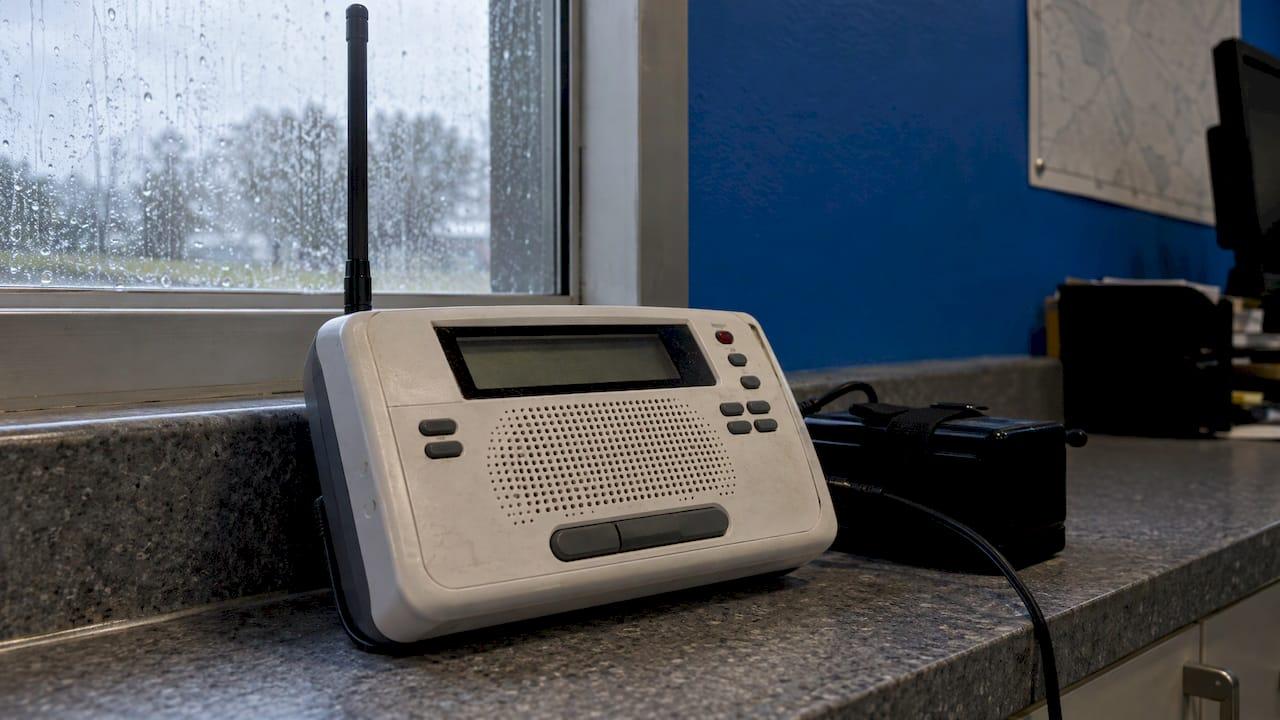
For organizations with staffed facilities, NWS Weather Ready guidance for organizations recommends continuous weather monitoring capability whenever the facility is staffed. It lists several ways to receive forecasts and warnings: an operational NOAA Weather Radio in a staffed location, iNWS text and email alerts, and bookmarked weather websites.
Redundancy applies to the tools themselves. The multi-agency Weather Ready checklist recommends options such as battery backup for NOAA Weather Radio and backup internet access through LTE, wireless, satellite or an alternate location. A storm that knocks out power and your broadband at the same moment is exactly when you need the forecast.

Set triggers that tell people when to act
The most common failure in severe weather planning is not a lack of information. It is a lack of agreement about what the information means. Triggers fix that by deciding in advance.
The Weather Ready checklist describes triggers as NWS watches, warnings or advisories, or defined thresholds such as 6 inches of snow or 50-mph wind gusts, paired with procedures for staff response. It suggests a plan may use several triggers for different response levels, and should define low, medium, high and extreme impacts along with the response to each. Evacuation plans belong in the document wherever they are needed.
A few principles make triggers usable:
- Write them as numbers or named products. "Strong wind" invites argument. "Sustained or gusting wind at the stated threshold, or a Severe Thunderstorm Warning for our county" does not.
- Account for the time to reach safety. The NWS Weather Watcher Guide makes the notification-and-evacuation interval an explicit planning question. A trigger that fires when the storm is overhead is not a trigger. If it takes 20 minutes to clear a field, your trigger has to fire with at least that much lead.
- Name who decides. The NWS Hazardous Weather Action Plan form asks for the persons, in order of authority, who will make the call to postpone, delay or cancel, so that nobody is searching for a decision maker mid-storm.
- Allow judgment, within limits. Florida State University's inclement weather guidance for outdoor events is designed to help identify when forecast or actual conditions require canceling or postponing an event, and notes that organizers should use best judgment to adjust triggers while accounting for other considerations.
The NWS action plan form adds a pre-event step: if hazardous weather is anticipated for the time the event is scheduled, consider plans to cancel or postpone. Deciding on Tuesday to move a Saturday event is far cheaper than deciding on Saturday at noon.
Plan communication, shelter and evacuation together
These three are one system. Alerts are useless without somewhere to go, and shelter is useless if people cannot reach it in time.
Alerting staff and attendees
The Event Ready Guide stresses that communication should be redundant, because poor communication can slow or even prevent response, and it recommends a backup plan where redundancy is not possible. The NWS Hazardous Weather Action Plan form asks organizers to identify a mode of communication to alert attendees when hazardous weather is possible or imminent, with a public address system, a message board or jumbotron, or a megaphone as examples.
Pre-notification costs almost nothing. The NWS severe weather planning guide notes that it can be done through an email to staff, a phone call or text message, bulletin board or ticket booth signage, and social media, so people stay alert for announcements if storms are expected.
Shelter and evacuation
Choose shelter locations on the basis of capacity, distance and access, not convenience. The Alliant guidance on outdoor event readiness says to define shelter, evacuation and restart procedures from expected attendance, site layout, crowd movement time and the needs of people who may require assistance, and to confirm shelter locations, capacity, alert-and-move time and route accessibility. The NWS action plan form provides blanks to identify shelter areas and the time necessary to clear the venue. Fill them in with a stopwatch, not an estimate.
If your event is a wedding or similar gathering with a fixed program, a rain plan is the lighter version of the same discipline. One venue's rain plan for an outdoor wedding shows how a backup space and a decision time can be built into the schedule, and a separate guide to rain plan ideas for barn weddings covers the layout side of moving people indoors.
Know what to do when a watch or warning is issued
Emergency procedures are most effective when they follow a simple ladder. FEMA's guide for alerts and warnings explains the practical difference between an advisory or statement, a watch and a warning: be aware, be prepared, take action. Build your plan around that ladder.
- Advisory or statement: the weather watcher flags it to the decision makers and checks the next update.
- Watch: conditions favor a hazard. Confirm shelter is open and staffed, review the announcement script, pre-position staff and prepare to interrupt activity.
- Warning: the hazard is occurring or imminent. Act.
The NWS action plan form says that when a threshold is triggered, all activities should be interrupted immediately and the recommended announcement wording should be read. Write that wording in advance, keep it short, and put it where the person holding the microphone can find it without thinking. Calm, scripted language prevents the improvisation that causes confusion.
Plan the restart as carefully as the stop
Most plans say precisely when to stop and say little about when to resume. The Alliant guidance stresses that restart criteria should be as explicitly planned as stop criteria, because conditions can look cleared while inspection, structural and system safety, and shelter-area readiness still need attention.
A restart checklist should cover:
- The weather condition that must be met, such as the warning expiring and no new product in effect.
- A physical inspection of staging, tents, power, walkways and signage.
- Confirmation that shelter areas have been vacated and returned to normal use.
- A named person who authorizes the restart and a time-stamped record of it.
For operations with security cameras, gates, networks and similar equipment, this is also the moment to confirm systems are working. One contractor's guide to hurricane prep for security systems frames that as a set of readiness tests worth running before and after a storm.
Train staff and rehearse the plan
A plan nobody has practiced is a document, not a capability. The NWS planning guide calls for documenting the plan, training all staff and holding seasonal sheltering drills. The Weather Ready checklist goes further for large organizations: run mock exercises that simulate a worst-case weather scenario and involve staff.
Make drills specific. Time how long it takes to move a full crowd to shelter. Test the public address system and the backup. Ask a volunteer who has never seen the plan to find the shelter from the far end of the site. Each drill should end with a short list of fixes and an owner for each.

Keep records that protect you afterward
Documentation is part of planning, not an afterthought. If a storm damages property, injures someone or triggers an insurance claim or lawsuit, the question becomes what you knew, when you knew it and what you did. The Alliant guidance recommends retaining time-stamped records, including:
- meteorological outlooks, alerts and warnings received
- the threshold that prompted action
- decision logs and approval records
- internal communications and public announcements
- photos and inspection reports
- shelter, evacuation and restart times
- incident reports and post-event reviews
Afterward, run a formal review. DHS and FEMA preparedness training explains that an after-action report identifies opportunities for improvement and addresses changes to plans and procedures, while an improvement plan resolves recommendations through concrete corrective actions. Treat every near miss as a rehearsal you did not have to schedule.
For organizations that set impact levels and response procedures as part of a broader enterprise risk program, this climate risk playbook for enterprise risk management shows how weather hazards fit into the wider framework.
Perspective: why forecasts alone are not a plan
We see the same pattern in nearly every engagement: organizations have access to forecasts, yet they lack a clear interpretation of what the forecast means for their specific site, schedule and people. Raw data does not tell an event director whether a line of storms will arrive before the gates open, or tell a facility manager which of three thresholds deserves a response.
That gap is why we work as certified consulting meteorologists rather than data providers. Our approach is to analyze high-impact weather for your operation, to offer same-day analysis when conditions are moving quickly, and to keep the service customizable, so the product fits an outdoor festival, a logistics yard or a courtroom.
The strongest plans we encounter put the meteorology at the front of the decision: thresholds tied to the time needed to reach shelter, a named decision maker and a record of every call. Climate-driven changes in extreme weather make that discipline more urgent each year, and we believe preparedness is a responsibility, not an option.
Michael
Getting a meteorologist involved
A written plan covers the routine. A meteorologist covers the judgment calls: whether the timing of a front justifies moving a start time, how to read a developing threat, and how to document the weather record for insurers or counsel after the fact.
WeatherPrep, LLC provides tailored event forecasts, on-site meteorology support for outdoor events and logistics, risk mitigation and adaptation reports for businesses, emergency management weather consulting, forensic reports for legal and insurance needs, and expert witness testimony. Our consulting meteorologists are certified, and we offer same-day analysis. If you want to know who qualifies for that title, our guide to the certified consulting meteorologist explains what a CCM is and when to hire one.

To discuss an upcoming event, a facility plan or a weather-related claim, see our consulting services or reach us through wxprep.com.
FAQ
How far ahead should I start watching the weather for an event?
The NWS Event Ready Guide advises starting weather monitoring at least three days before the event. Assign a weather watcher who reviews the Hazardous Weather Outlook and local forecast and forwards potential impacts to decision makers. Increase the frequency of checks as the event approaches.
What should a severe weather plan include at minimum?
It should answer which hazards could affect the event, where people will shelter or evacuate, how they will be alerted, and how long notification and evacuation will take. Add named decision makers, written triggers, announcement wording, restart criteria and a record-keeping procedure.
What is the difference between a watch and a warning?
FEMA's guidance describes a watch as a signal to be prepared and a warning as a signal to take action. In a plan, a watch means confirming shelter and staffing, while a warning means interrupting activities and moving people.
Do small businesses and venues need a formal plan?
Yes, the same four questions apply at any size. A small operation can use a one-page version with a named weather watcher, two or three triggers, a shelter location and a call list. The NWS publishes a blank hazardous weather action plan form that can serve as the template.
Why keep records of weather decisions?
Time-stamped alerts, thresholds, decisions and restart times show what was known and what was done. They support insurance claims, legal review and your own after-action report, which identifies improvements to plans and procedures.
Sources
- Severe Weather Planning Guide, National Weather Service
- Event Ready Guide, National Weather Service
- Weather Prepared Organization, National Weather Service
- Weather Ready Checklist: Multi-Agency, Large Organization
- Blank Hazardous Weather Action Plan, National Weather Service
- Inclement Weather Guidelines for Outdoor Events, Florida State University
- Weather Watchers Guide, National Weather Service
- 5 Step Severe Weather Plan for Outdoor Event Readiness, Alliant
- A Guide for Alerts and Warnings, FEMA
- After-action review, FEMA Emergency Management Institute