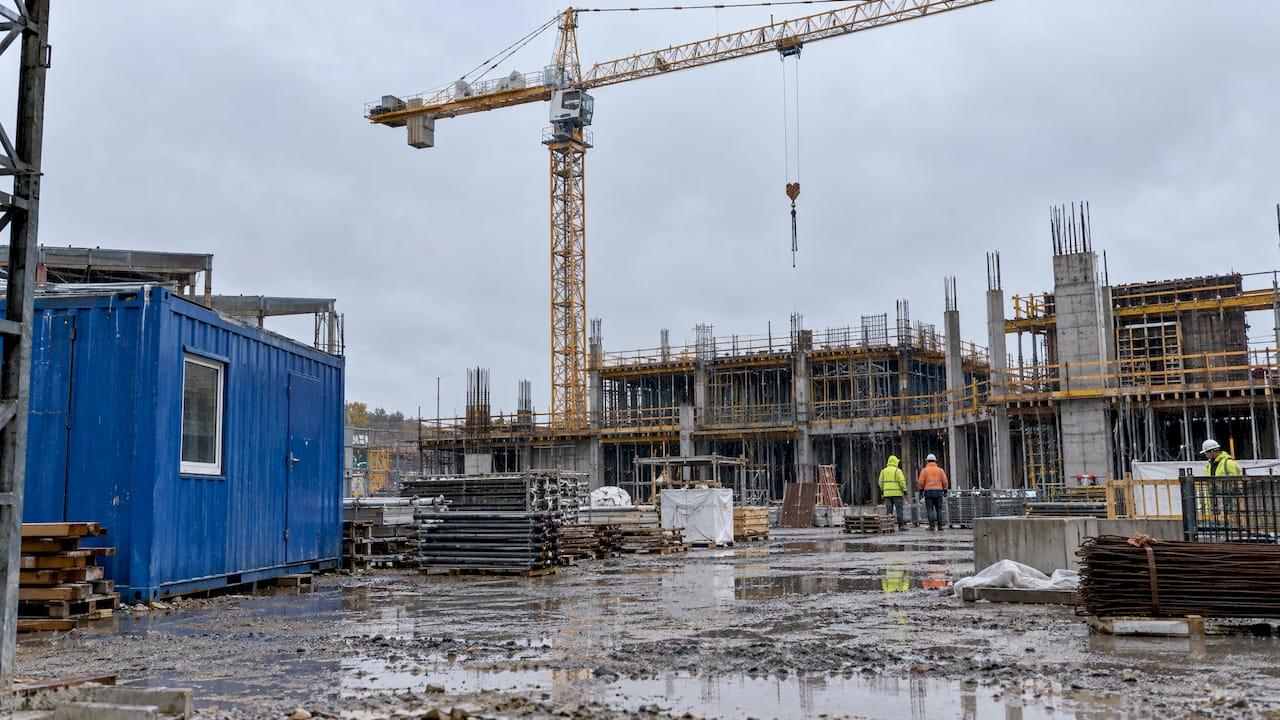
Construction weather delays are usually treated as excusable but non-compensable. The contractor typically earns more time and not more money, and only when the weather actually stopped work that controlled the schedule. Whether a given storm qualifies depends on your contract language, on measured weather data, and on how well the impact was documented at the time. This guide covers what causes the delays, how contracts treat them, who gets paid when work stops, and how to build a defensible record.
TL;DR
- Weather delays about 45% of construction projects worldwide, and extreme temperatures, precipitation and high winds do the most damage.
- Under most contracts a weather delay is excusable and non-compensable: a time extension, rarely extra money. Pappas Grubbs Price notes that owner-caused delays are the usual route to compensation.
- Many public owners set measurable thresholds, such as half of a workday lost on controlling work, before a day counts.
- Claims succeed on contemporaneous notice, daily logs, historical weather comparisons and proof that the critical path was affected.
- Planning for weather up front, with seasonal allowances and a rain-day task list, is cheaper than arguing about it afterward.
Table of Contents
- Which weather conditions delay construction work
- What weather delays cost
- Excusable, compensable and concurrent delays
- Do construction workers get paid when rain stops work?
- Proving a weather delay hit the critical path
- What records and weather data to keep
- Planning to reduce weather delays
- Perspective: why the weather record deserves a specialist
- Get a weather record you can rely on
- FAQ
- Sources
Which weather conditions delay construction work
Three conditions do most of the harm. A 2021 systematic review in Sustainability found that extreme temperatures, precipitation and high winds are the most impactful weather conditions on construction. Each one hits different trades in different ways.
| Condition | Activities most affected | What goes wrong |
|---|---|---|
| Rain and flooding | Excavation, concrete pours, exterior work, earthworks | Work halts, excavations fill with water, finishes are damaged |
| Freezing temperatures and snow | Trenching, paving, brickwork, material handling | Frozen ground, mortar and concrete damage, slow handling |
| High wind | Crane operations, roofing, exterior lifts, hot work | Lifts become unsafe, fire risk rises |
| Extreme heat | Concrete placement, crews outdoors, equipment | Rapid drying and cracking, fatigue, overheating |
The table follows the activity lists in a UK planning guide from FORGE Command, which names concrete, masonry, roofing, external coatings, earthworks, cranes and hot works as the most weather-sensitive operations.
Note that the delay is often not the storm itself. Wet ground can keep heavy equipment off a site for days after the rain stops, and a single high-wind morning can push a crane-dependent sequence back by a week if the next lift window is booked. That is why a precise hourly record matters more than a daily rainfall total.
What weather delays cost
The figures vary by region and method, but they are never trivial. A 2025 survey of 242 industry experts in Buildings found that weather-related delays lengthened project durations by 25.7% and raised costs by an average of 23.8%. The same 2021 review reports that even light rain (under 4 mm per 12 hours) can cut labor productivity by up to 40%, and heavy snowfall can reduce crew efficiency by 35%.

People matter as much as schedules. Revay's analysis of weather and productivity describes how hot and cold weather affect crews physically and psychologically: cold brings injury risk and trouble with fine handling, while heat brings exhaustion, dehydration and more breaks. Those effects reduce output on days when work technically continues, which is a form of disruption that is harder to claim than a full stoppage.
UK experience on HS2 shows the same pattern. A HS2 Learning Legacy paper notes that adverse weather affects cost, programme, quality and safety, and that wet or icy surfaces raise the risk of slips, trips and falls.
Excusable, compensable and concurrent delays
Most disputes come down to vocabulary, so it helps to define the terms.
- Excusable delay: a delay the contractor did not cause and should not be penalized for. Unusually bad weather is the classic example.
- Non-compensable delay: the contractor gets time but no added money for extended overhead or equipment standby.
- Compensable delay: the owner or its representatives caused the delay, so the contractor can recover costs as well as time.
- Concurrent delay: an owner-caused and a contractor-caused delay overlap.
The City of Los Angeles Bureau of Engineering lists excessive inclement weather among excusable non-compensatory delays and says a no-cost time extension should be issued only if the delay affected the contract completion date. It treats concurrent delay the same way: time, but no compensation. Law firm commentary agrees that unforeseeable events outside either party's control are generally not compensable, though a time extension may be warranted.
Contracts differ, so read yours. Some shift weather risk entirely onto the contractor, some grant relief only for unusually severe events, and some add a pre-agreed number of weather days. Under international FIDIC forms, for example, the Red and Yellow Books allow an extension of time for exceptionally adverse climatic conditions and may allow recovery of prolongation costs, while the Silver Book removes that ground. That is a reminder that the same storm can produce different outcomes under different paper.
How owners define a weather day
Public agencies often replace "unusual weather" with numbers. Three examples from US owners:
- The Florida DOT justifies weather extensions only when weather leaves the contractor unable to work at least 50% of a normal day on controlling work items, or when major repairs to weather-damaged work are needed (CPAM 7.2, revised March 2025).
- The Tennessee Department of General Services defines adverse weather as precipitation over 0.10 inches, temperatures too low for the day's activity, or sustained wind above 25 mph, and allows a weather delay day request when critical path work is prevented for 50% or more of the scheduled workday.
- Contract commentary from Australia suggests categorizing events as moderate, severe or extreme using daily rainfall, wind speed and temperature bands, written into the contract so no one argues about the definition later.
The lesson is consistent: a threshold agreed in advance, tied to the work that controls completion, is far easier to apply than a judgment made after the fact.
Do construction workers get paid when rain stops work?
Sometimes, and it depends on classification and jurisdiction. In the United States, the Fair Labor Standards Act framework as summarized by WorldatWork says hourly, non-exempt employees must be paid only for hours actually worked when bad weather closes or affects the workplace, while salaried exempt employees' pay depends on whether the workplace is closed and whether they perform any work. A Littler employment law report adds that when an employer shuts down for less than a full workweek because of weather, exempt employees generally must receive their full salary, and docking it risks the exemption.
Union agreements, state rules and company policy can add reporting-pay or weather-pay provisions, so check the applicable agreement. Other countries differ: Australia's Building and Construction General On-site Award pays ordinary hourly rates for a limited number of hours when inclement weather prevents any work. Payroll questions are best settled with an employment lawyer or your HR counsel.
Proving a weather delay hit the critical path
This is where many requests fail. Bad weather on a day is not the same as a delay to completion. A weather day only extends the contract when the affected activity sits on the critical path, or has consumed its float. Scheduling specialists make the same point: before asking for time, confirm the weather impact reached the critical path, and submit requests regularly and contemporaneously, not at project end.
A practical sequence:
- Start with the baseline schedule and mark the activities that are weather-sensitive.
- Record the actual weather for each day from a source the contract recognizes, at the site or the nearest station.
- Compare with the contract threshold. Did conditions exceed the defined limits, or the historical norm for that month?
- Log what work was prevented, how many crew-hours were lost and what repairs were needed.
- Update the schedule with the actual weather days and see whether the completion date moved. If it did not, float absorbed the loss and no extension is owed.
- Submit notice and the request within the contract's time limits.
If the schedule shows that the activity had float, or that another non-weather problem was driving completion, the weather claim will weaken. If weather and a contractor-caused problem overlapped, the owner will likely call it concurrent and grant time only.
What records and weather data to keep
Contract language comes first. If it specifies a method, follow it. HLC advises using historical data to show conditions were extreme, following any method the contract prescribes (such as a 10-year average of monthly temperature or average days above a rainfall level), and, where the contract is silent, drawing on a period of data several times the length of the contract. The same source warns that if conditions fall outside averages but are part of a widely reported trend, the other side may argue the weather was extreme but not unforeseeable.
For day-to-day evidence, keep:
- Daily reports noting weather, crew counts, equipment on site and work stopped, signed and dated.
- Photographs and video with timestamps, including standing water, wind damage and frozen ground.
- Site or nearby station readings: rainfall totals, hourly wind and gust speed, temperature.
- Written notice to the other party. One Australian contract guide recommends initial written notification within 48 hours specifying the cause, impacts, durations and any damage. Your contract may set a different deadline, and missing it can forfeit the claim.
- Records of recovery steps: pumping, protection, resequencing and remedial work.
When the amount at stake is large, or the weather event is disputed, a certified consulting meteorologist can reconstruct what happened hour by hour at the exact location. Our overview of forensic meteorology services explains what such a report covers, and flooding cases are covered in flood damage assessment and documentation.
Planning to reduce weather delays
The cheapest weather delay is the one already in the schedule. Experienced planners add weather allowances to weather-sensitive activities based on historical data and season, commonly 10 to 15 percent contingency for external works in summer and 20 to 30 percent in winter. Treat those as rules of thumb to calibrate against local climate records, not as standards. HS2's learning paper cites research suggesting that longer-range planning could cut project durations by 16% by minimizing weather-related delays.
A few habits that pay off:
- Sequence around the season. Put roofing, foundations and envelope work ahead of the wet or cold months where the project allows.
- Protect early. Temporary protection, drainage and covered material storage belong in the plan from day one, not after the first storm.
- Keep a rain-day task list. Identify interior work, prep tasks and paperwork that can move forward when exterior work cannot, so weather days are not wasted days.
- Set wind and lightning rules. Define crane and lift limits and a stand-down procedure before they are needed.
- Use a short-range forecast daily. Decisions on pours, lifts and crews depend on hour-by-hour guidance, not a regional outlook.
The same logic applies to any outdoor operation. A one-page weather contingency plan built around triggers, decision makers and backup actions is a useful model for site teams as well as event crews. Our guide to severe weather planning for organizers and businesses walks through the same trigger-and-response approach.
Looking further ahead, researchers argue that existing delay models rarely account for changing future climate, and urge planners to identify weather-vulnerable activities and build the capacity to respond. Historical averages alone may understate risk on projects that run for years.
Perspective: why the weather record deserves a specialist
We see the same pattern on delay disputes. Both sides arrive with a rainfall total from the nearest airport, and neither can say what actually happened on the site, at the hour the crew stood down. A daily total cannot answer whether a pour was safe at 7 a.m. or whether gusts exceeded a crane's limit at 2 p.m.
Our work as certified consulting meteorologists is to go beyond raw data and explain the implications: what the atmosphere did, how it compares with the historical record for that location and season, and whether it was severe enough to meet the contract's definition. Because we offer same-day analysis, that answer can arrive while the notice period is still running, not months later.
The strongest position is built before there is a dispute. Define thresholds, collect station data and keep a clean daily log. When a claim or defense does go forward, a clear forensic report and, if needed, expert testimony give owners, contractors, insurers and counsel a shared factual basis.
Michael
Get a weather record you can rely on
Whether you are preparing a delay notice, defending against one, or building a weather risk plan for the next project, WeatherPrep provides forensic weather reports, expert witness testimony, risk mitigation reports and rapid turnaround analysis from certified consulting meteorologists. Review everything on our services page or start from our forensic reports offering.

If a claim is already in dispute, our article on the meteorologist's role as an expert witness explains what testimony involves.
FAQ
Are weather delays excusable in construction?
Usually yes, if the weather is beyond what the contract expects and prevents work that controls completion. Many owners define the threshold in numbers, such as losing half of a workday. Excusable generally means extra time, not extra money.
Can a contractor recover money for weather delays?
Rarely, when the weather is the sole cause. Delays caused by an owner's action or inaction may be compensable, and some contracts, such as certain FIDIC forms, allow cost recovery for exceptionally adverse conditions. Your contract and counsel decide the outcome.
What weather data supports a delay claim?
Use measured rainfall, wind, gust and temperature data for the site or nearest station, compared with historical records for the same month. Follow the contract's method if it has one. Pair the data with daily logs and photos showing what work was lost.
Do construction workers get paid if it rains?
It depends. In the US, hourly workers are generally paid for hours actually worked, while exempt salaried employees may still be owed full salary depending on the shutdown. Union agreements and state rules can change this, so confirm with HR or employment counsel.
Sources
- Weather-Related Construction Delays in a Changing Climate (Sustainability, MDPI, 2021)
- The Influence of Weather Conditions on Time, Cost, and Quality (Buildings, MDPI, 2025)
- Weather Delays in Construction: Plan & Recover (FORGE Command)
- The Impact of Weather on Productivity (Revay)
- A Weather Resilient Approach to Construction (HS2 Learning Legacy)
- 18.4 Analyzing Delays/Granting Time Extensions (City of Los Angeles Bureau of Engineering)
- The Basics of a Construction Delay Claim (Pappas Grubbs Price)
- Managing extreme weather-related delay and disruption claims (HLC)
- CPAM 7.2 (Florida Department of Transportation)
- Section 01 26 20 Weather Delays (Tennessee Department of General Services)
- Extreme Weather Delays & Contracting Tips (Troy Legal)
- Who Gets Paid When Bad Weather Shuts Down Work? (WorldatWork)
- A Littler Report on natural disasters
- Building and Construction General On-site Award 2020 (Fair Work Ombudsman)
- How to Estimate and Track Weather Delays in Construction (SmartPM)
- One Page Weather Contingency Plan (Atelier by RASA)