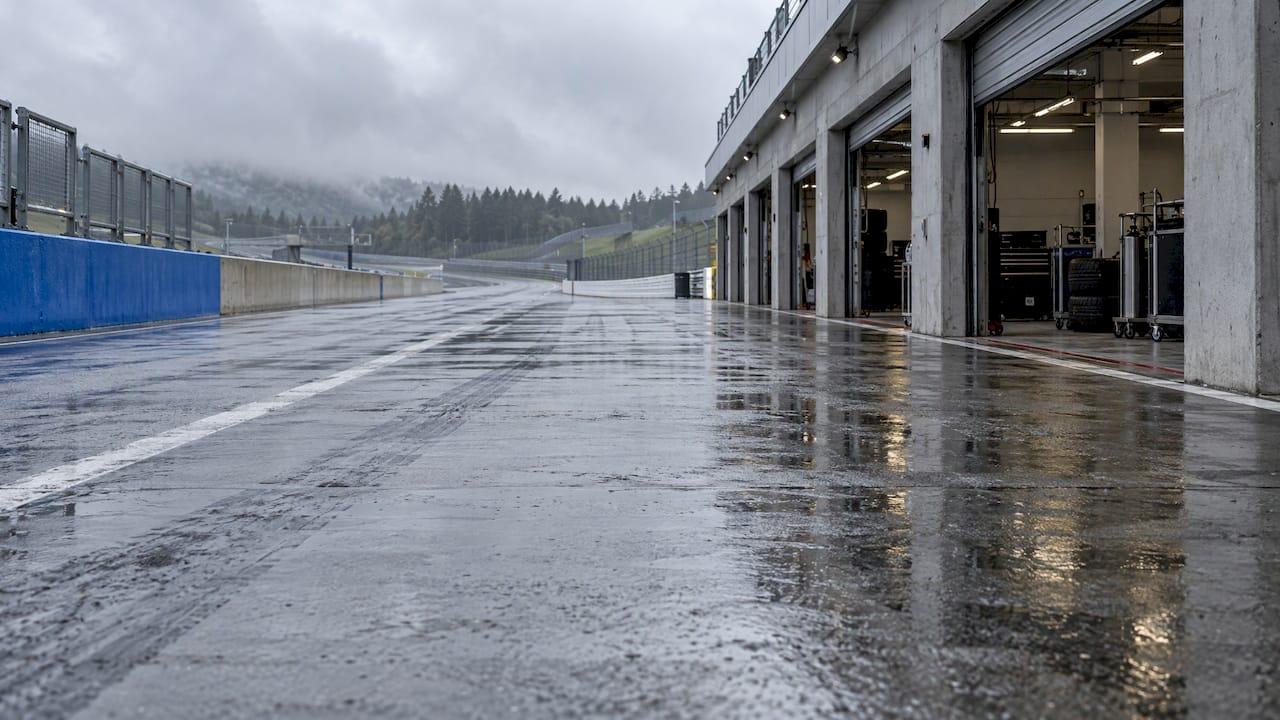
Race day weather is not the number on a general forecast app. It is rain timing, wind direction, track temperature and lightning risk for your venue, across the hours your event runs, with a named person who can tell you what to do about it. For organizers, that takes a venue-specific forecast from a certified consulting meteorologist, ideally one who answers the same day and can stand at the circuit with you. That is what we provide at Wxprep.
TL;DR
- A useful race-day forecast covers your site and your event hours, not the nearest city across a whole day.
- Start monitoring at least three days out, tighten the routine as the event nears, and keep watching during the event.
- Rain, wind and temperature each change what is safe: grip, visibility, handling, tire behavior and track drying time.
- Set decision thresholds and a decision-maker before race morning, so a forecast turns into an action.
- A meteorologist who interprets radar and models for your venue turns raw data into a call you can defend afterward.
Table of Contents
- What a race-day forecast actually has to say
- How weather changes a race
- When to start watching, and how often
- Reading uncertainty without freezing
- Why a meteorologist at your venue beats a screen
- After the race: when weather becomes evidence
- Where Wxprep fits
- Our perspective
- FAQ
- Sources
What a race-day forecast actually has to say
A general forecast answers whether it will rain somewhere in a region today. A race needs a different answer: when rain arrives, when it leaves, how hard it falls, how much accumulates and which part of the course is hit first. Formula 1 describes its own race-day forecasts in exactly these terms, reporting rain arrival and departure to the minute, with intensity, amount and the first corner affected, built from localized radar, trackside stations, forecast models and live updates.
The scale matters. Autosport reports that teams need localized forecasts of rain timing, temperature and wind over an area of a few kilometers and a window of roughly 90 minutes, not a broad outlook. Most events are not Formula 1, but the principle carries to a regional motorsport weekend, a charity 10K, a cycling criterium or a triathlon: the forecast must match your footprint and your schedule.
A race-day product should include:
- Hour-by-hour precipitation timing and intensity for the venue
- Wind speed, gusts and direction, with attention to exposed sections
- Air temperature, and for motorsport, the temperature trend that drives surface and tire behavior
- Lightning and thunderstorm timing, which drives shelter decisions for spectators and staff
- A plain statement of confidence, so you know what is likely and what is still open
The same hyperlocal logic applies to any outdoor event, and we cover it in hyperlocal event forecasts.
How weather changes a race
Each element acts differently, and organizers need to know which one is driving a decision.
Rain and surface water
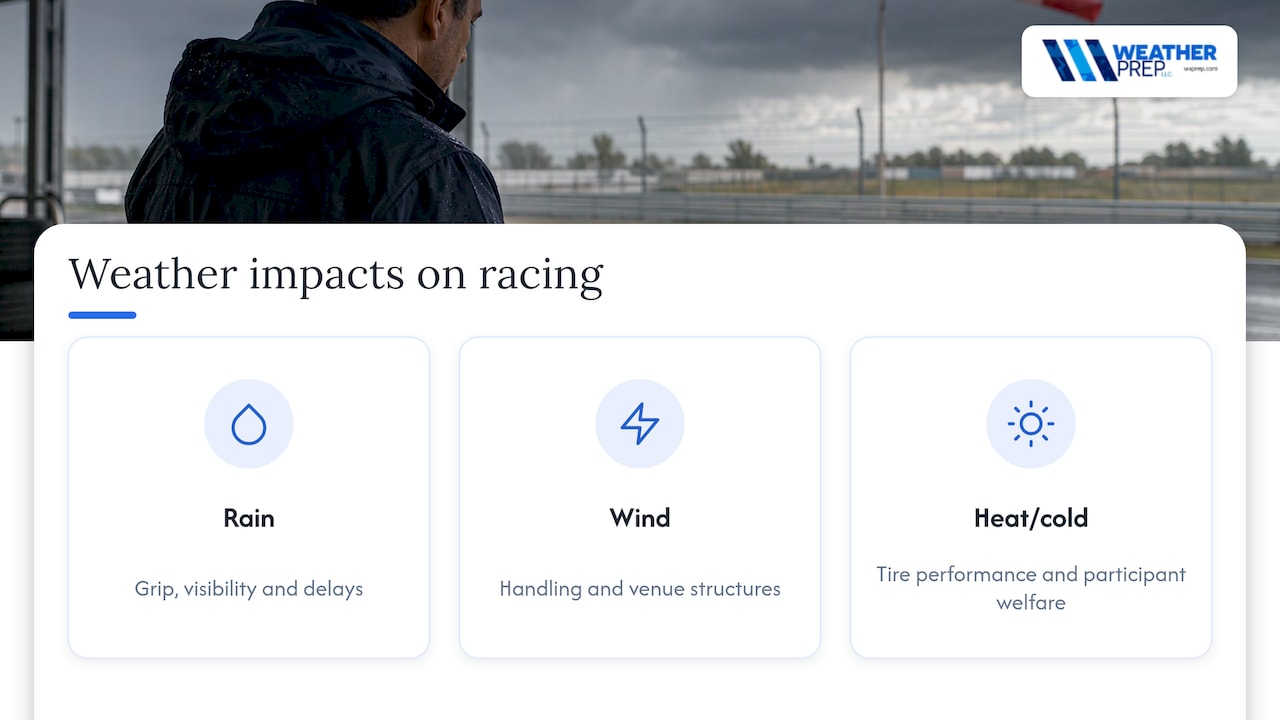
MotoGP explains that wet asphalt reduces grip, limits cornering lean and affects braking and acceleration, while spray cuts riders' visibility. Weather can delay a start, shorten a race or prompt a red flag. At NASCAR's Daytona track, any rainfall can delay racing because of the hazards at roughly 200 mph, and drying can take from 90 minutes to a few hours. Even for a footrace or ride, the drying and cleanup time belongs in the schedule.
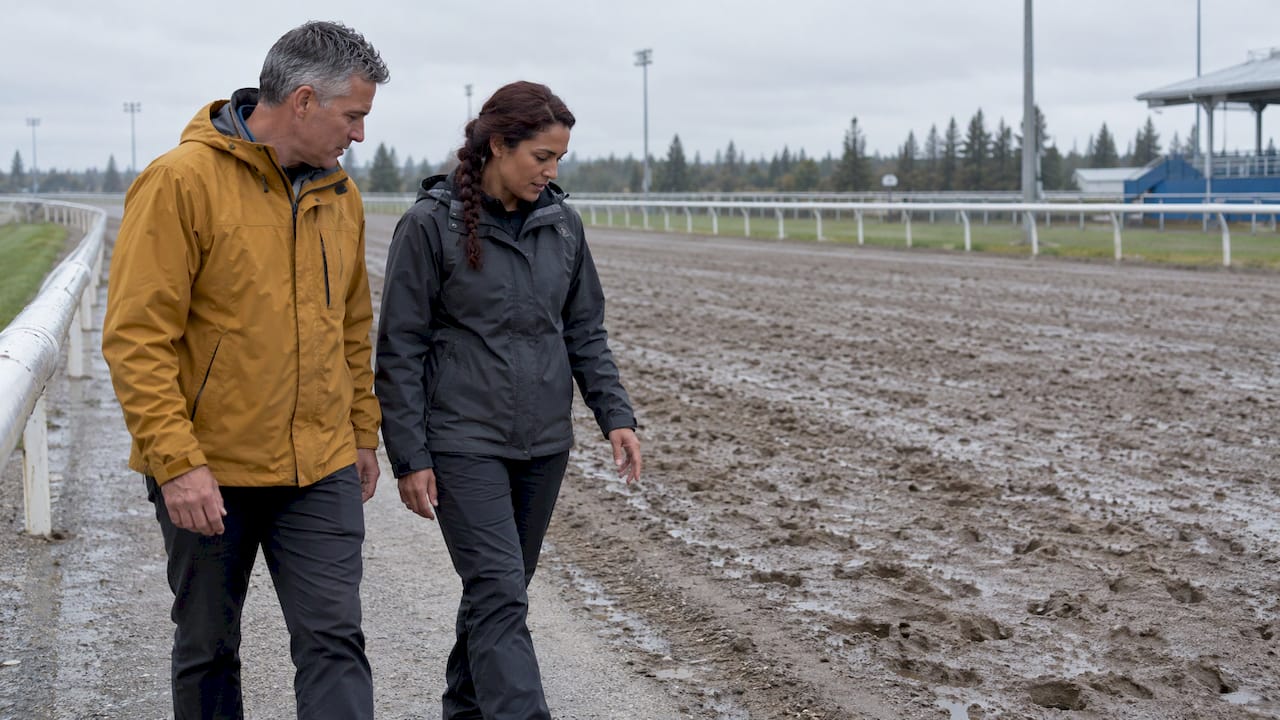
In horse racing, a published protocol shows how formal this can be: the Alberta Horse Racing Association directs track superintendents to monitor forecasts and the amount, duration and timing of precipitation, and to assess the surface with the regulatory veterinarian before racing resumes.
Wind
The Royal Meteorological Society notes that heavy rain reduces visibility and can lower brake temperatures, while gusts can affect aerodynamic handling. Direction matters as much as speed: Autosport reports that wind direction can change aerodynamic performance, and crosswinds affect cars differently depending on their sensitivity to yaw. For organizers of any race, wind also means tents, banners, timing gantries and start structures.
Heat and cold
MotoGP notes that heat and cold affect tire performance. The Daytona report adds that heat and wind may affect handling and hazards even when they do not postpone or cancel an event. For runners and riders the same swing becomes a participant-welfare question: hydration stations, medical staffing and cutoff times.
Not every bad forecast stops a race
The Royal Meteorological Society says Formula 1 races proceed in all but the most extreme weather, and that conditions forcing cars to run too slowly can be especially likely to cause delay. The lesson for organizers is to define in advance which conditions trigger which response, rather than deciding under pressure.
When to start watching, and how often
The National Weather Service's Event Ready Guide recommends starting weather monitoring at least three days ahead. Point forecasts extend seven days, with uncertainty generally growing farther out, and the guide's checklist calls for a daily assessment before the event and continuous monitoring during it.
Other bodies are more conservative. Triathlon Ireland advises organizers to begin monitoring at least 10 days before an event and to prepare a decision chain and communications plan. At the top of motorsport, race engineer Mark Temple said teams consider long-range weather a week or more out and start using the official circuit forecast on the Wednesday of race week.
A workable rhythm for a US weekend event:
| Timing | What you do |
|---|---|
| 7 to 10 days out | Note the broad pattern; confirm contingency options exist |
| 3 days out | Begin daily assessment; brief your decision-makers |
| 1 to 2 days out | Check every morning; compare against observed conditions at the venue |
| Race morning | Get a site-specific update matched to your start and finish times |
| During the event | Continuous monitoring, with a direct line to the person who interprets it |
The YRA of San Francisco Bay's race-committee guidelines advise checking forecasts every morning in the final two days and on race morning, then comparing forecasts with the wind actually observed at the venue. That last habit is the one most organizers skip. Watching how the real conditions track against the forecast tells you whether to trust the next update. We explain the live side in real-time weather monitoring.
Reading uncertainty without freezing
Forecasts change, and confidence typically rises as the event approaches, according to the NWS Weather Watcher Guide. The practical questions are about timing and thresholds.
Match the forecast to your hours
A daily rain chance is not a race-window rain chance. Motor Sport Magazine's analysis of Spa made the point: a 90% chance of rain on the day did not mean a 90% chance during the race, which might be 35 to 40%, or somewhat more or less. Ask for the probability for your start-to-finish window, not the day.
Be wary of false confirmation
The YRA guidelines caution that several weather websites may display the same underlying model, so checking five apps is not five independent opinions. Compare genuinely different sources, or have a forecaster do it for you.
Decide in advance, because setup choices lock in early
The same Spa analysis notes teams had to settle rear-wing levels more than 24 hours before the race, forcing a trade-off between dry speed and wet downforce under uncertain forecasts. Organizers face the same pattern with porta-toilet placement, tent orders, medical staffing and staging. Our guide to reading forecast uncertainty shows how to turn a probability into a decision.
Set thresholds and name the decision-maker
The NWS recommends planning event-specific thresholds, shelter or evacuation timing, communications and decision authority, and contacting a local forecaster when conditions are near a critical threshold. Write the triggers down before race week: the wind gust that pauses a start, the lightning distance that clears a course, the rainfall that moves the schedule. Our festival weather planning guide walks through trigger-setting in detail, and the approach carries directly to races.
Why a meteorologist at your venue beats a screen
Radar shows where rain is. It does not tell you what to do. Formula 1's trackside meteorologist Steffen Dietz argues that a localized cloud may miss the circuit by hundreds of meters, and that radar combined with a human forecaster improves interpretation. Mark Temple adds that radar is hard to use alone for precise judgment, and that a concise statement about imminent heavy rain is what makes the information operational.
That is the gap between data and a decision. Seeing a rain cell on a map is easy. Knowing whether it will weaken before reaching the start line, and what that means for your 10:15 start, is a professional judgment. Public tools can supplement it: live public cameras, such as the Finnish road weather camera feeds, show how conditions look at a given location, but a camera cannot give you the next 90 minutes.
The Met Office, the UK national weather service, offers site-specific forecasts up to seven days ahead with hourly detail and an on-site operational meteorologist for high-profile events. The model is established: for events where a wrong call is costly, the forecaster stands with the organizers.
After the race: when weather becomes evidence
A race-day forecast looks forward. A forensic weather report looks back. It reconstructs what conditions were at a precise place and time, for an insurance claim, a liability dispute or a cancellation dispute. The two share data, but the forensic version must withstand cross-examination, and the quality of your contemporaneous record matters. If a race was delayed or called off, the forecasts you received, the thresholds you set and the observations you logged all become part of the story. Our explainer on how meteorologists reconstruct a storm shows how this analysis works, and what a meteorologist does in court covers testimony for attorneys, including those handling cases in New York and New Jersey.
Where Wxprep fits
We are certified consulting meteorologists, and our services include event forecasting, on-site meteorology support for outdoor events, emergency plans, risk mitigation, forensic reports and expert witness testimony. We offer same-day analysis and customizable services with direct access to the meteorologist, so the person interpreting the radar is the person you can call. For a race, that means a forecast built around your course and schedule, and a clear recommendation when the weather nears your thresholds.
See our event forecasting and other services to book an engagement for your next race, or read about what meteorological consulting includes.

Our perspective
The most common mistake we see in race planning is treating weather as a number to check rather than a decision to make. A rain chance means little until someone has said what it means for the start, the course, the crowd and the clock.
Our approach is to give organizers a forecast shaped around their event hours, with a certified consulting meteorologist behind it who can explain confidence and timing in plain terms. When a threshold is near, you should be able to pick up the phone and get an answer the same day.
The best race-day weather plan is written before race week: thresholds, a decision-maker, a communication chain and a forecaster who knows your venue. Then race morning is about executing, not improvising.
Michael
FAQ
Can rain delay a NASCAR race?
Yes. Reporting on Daytona notes that any rainfall can delay racing because of the hazards at roughly 200 mph, and that drying the track can take 90 minutes to a few hours. Wet weather can also shorten or stop a race.
How far ahead should I check the weather for my event?
The National Weather Service recommends starting at least three days ahead, with daily assessment as the event nears and monitoring throughout. Some event bodies advise beginning up to 10 days out.
What does a 60% chance of rain mean on race day?
It describes the probability for the forecast period and area, not necessarily your event hours. Ask for the chance during your start-to-finish window, since a daily figure can be far higher than the race-period figure.
Do I need an on-site meteorologist?
For events with large crowds, tight schedules or costly cancellation decisions, an on-site meteorologist interprets radar and observations for your exact venue and advises on thresholds in real time. We provide on-site meteorology support for outdoor events.
Sources
- Watching the skies: how weather forecasting works in F1
- F1 and the weather, Royal Meteorological Society
- Why weather isn't a true F1 leveller, Autosport
- How Does Weather Impact MotoGP Races?
- Hazardous Weather Protocol, Alberta Horse Racing Association
- How rain can impact NASCAR's Daytona 500
- Event Ready Guide, National Weather Service
- Weather Watcher Guide, National Weather Service
- Event management, Met Office
- Adverse Weather at Events, Triathlon Ireland
- YRA Race Committee Guidelines
- Why F1 teams have to wing it when rain is forecast at Spa, Motor Sport Magazine
- Fintraffic weather cameras