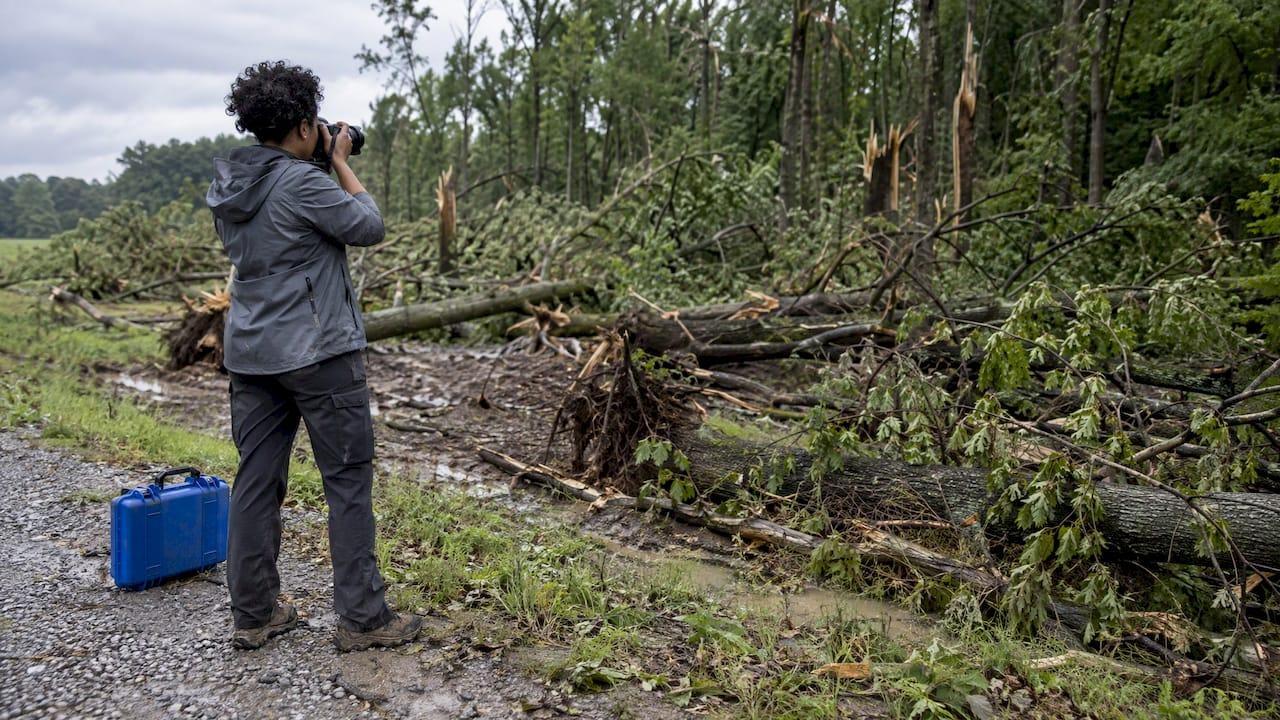
Extreme weather analysis is the work of establishing what a severe event actually did at a specific place and time: the wind speeds, rainfall or snow load, the timing, and the cause of the damage that followed. For event organizers, insurers, attorneys and risk managers, the value lies in a defensible answer, not a general weather summary. That answer comes from a certified consulting meteorologist who combines radar, station observations and field evidence into one account. At WeatherPrep, our consulting meteorologists provide this analysis with same-day turnaround, as forensic reports, expert testimony and event forecasting.
TL;DR
- Extreme weather analysis reconstructs an event from observations, radar, satellite and damage evidence, then states what happened at a particular address or venue.
- Official survey methods, such as the National Weather Service's damage indicators and the EF scale, give wind damage a documented, repeatable basis.
- Observed weather, forecast conditions and climate attribution are three different questions, and a good report keeps them separate.
- Public storm databases can be imprecise, so a forensic analysis cross-checks several sources before it names a date or a wind speed.
- Same-day turnaround matters: insurers, counsel and operations teams make decisions in the first hours and days after an event.
Table of Contents
- What extreme weather analysis actually covers
- What severe storms do to people, property and operations
- How analysts reconstruct an event
- Observed, forecast and attributed: three different questions
- Wind, rain and snow: separating causes of damage
- Turning analysis into recovery, claims and testimony
- Data limits a decision-maker should plan around
- Working with WeatherPrep
- Our perspective
- FAQ
- Sources
What extreme weather analysis actually covers
A forecast says what is likely to happen. An analysis says what did happen, and why it matters to a particular decision. Most readers who need one fall into four groups:
- Event organizers and logistics teams who must decide whether to hold, delay or evacuate an outdoor event, and who later need a record of the conditions that drove the decision.
- Insurance carriers and adjusters who need to confirm whether a reported storm reached a property on the date of loss.
- Attorneys who need a qualified expert to explain weather conditions to a judge, jury or mediator.
- Businesses and emergency managers who need to understand how often damaging conditions occur and what they do to operations.
The same underlying science serves all four. What changes is the question: "Should we proceed?", "Did it happen here?", "Can you testify to it?" or "How exposed are we?"
What severe storms do to people, property and operations
The scale of the problem sets the stakes. Climate Central's tally of billion-dollar weather and climate disasters for 2025, reported by TIME, counted 23 such events in the United States, with 276 fatalities and $115 billion in damages. Severe convective weather, which includes tornado outbreaks and a derecho (a long-lived line of damaging straight-line winds) that struck the Northeast in April, made up 91% of those events.
For a business or organizer, the direct damage is only the first layer. The Cybersecurity and Infrastructure Security Agency describes severe storm impacts on critical infrastructure in two stages. The initial damage comes from lightning, large hail, high winds, tornadoes and local flooding. The secondary effects follow: delayed power restoration, damaged or delayed supply chains, structural instability that delays a return to operations, and debris, evacuations and outages across the surrounding community.
That sequence explains why analysis has to be fast and specific. A venue that loses power for two days, a warehouse with a damaged roof and a delivery fleet stuck behind downed trees all raise the same questions: what was the weather, how severe was it, and what documentation supports the claim or the decision?

How analysts reconstruct an event
The most mature method in the United States is the National Weather Service damage survey. According to the NWS, survey teams reconstruct a tornado's life cycle using GPS, cameras, damage-survey software, eyewitness accounts and radar data. They then match what they see to one of 28 damage indicators and assign a degree of damage with wind-speed bounds. Those bounds are adjusted for construction quality, and the result is the tornado's rating on the Enhanced Fujita (EF) scale.
The NWS gives a sense of how fine that scale is. For a one- or two-family residence, broken glass implies an expected wind speed of 96 mph, with bounds of 79 to 114 mph. Collapse of all interior and exterior walls implies 170 mph, with bounds of 142 to 198 mph. The same page explains that construction quality moves the assigned value between the expected, lower-bound and upper-bound speeds, which is why two similar-looking houses can receive different ratings.

A NWS presentation on streamlining the tornado survey process lists what a survey is supposed to deliver: documentation for the official record, a distinction between tornado, straight-line wind, microburst and hurricane or tropical-storm damage, the location of the strongest winds, a wind estimate with an EF rating, and the path length, width and start and end times.
Field evidence and the written report
The European Severe Storms Laboratory's guide to wind damage surveys (version 1.1, September 2024) advises taking multiple cross-sections through large damage areas to establish how damage progresses along a path. It asks for a summary stating maximum intensity, path length, mean and maximum width, areas affected by different intensities and a track map.
A peer-reviewed method in Natural Hazards and Earth System Sciences, refined across 136 field surveys in Spain between 2004 and 2018, produces three deliverables: a standardized text report, a table of geolocated damage points, and a map file. It can also identify whether the phenomenon was a tornado, a downburst or straight-line wind even when no witness reports exist, by reading damage patterns in forests and the spread of debris.
These are the same ingredients a client should expect from a forensic weather report: a clear timeline, the instruments and imagery behind it, geolocated evidence, and a conclusion that states how strong the conditions were at the location in question.
Why records need documentation
The World Meteorological Organization applies the same discipline to climate records. Its evaluation process for weather and climate extremes requires a background report documenting the exact location, the instrument type, model, serial number and calibration details, the synoptic and regional weather context, and any unusual circumstances. If a record-setting reading needs that much paperwork, a claim or a legal dispute does too.
Observed, forecast and attributed: three different questions
Readers often mix up three kinds of statements, and a careful analysis keeps them apart.
- Observed weather: what instruments, radar and field evidence show happened. This is what a claim or lawsuit usually turns on.
- Forecast conditions: what was predicted and when it was communicated. This matters for event decisions, duty-of-care questions and whether a warning was available.
- Attribution: whether and how much climate change altered the likelihood or intensity of an event. This is a research question and rarely the one a claim hinges on.
The National Academies describe extreme event attribution as a four-step workflow: define the event's spatial and temporal boundaries and metrics, design a counterfactual, compare probability and magnitude between the actual and counterfactual worlds, and communicate the result with confidence estimates. Definition alone is not trivial. World Weather Attribution notes that the same heatwave can be framed as three days above 30°C in London or ten days above 25°C across England and Wales, so modern studies calculate results for several definitions.
The practical lesson for a client is to ask exactly what the report is meant to establish and to define the event the same way in every document. Theodore Shepherd's framework for event attribution separates a probabilistic, risk-based approach from a storyline approach that examines the factors behind the event as it unfolded. For a claim or case, the storyline view is closer to what is needed: what the atmosphere did on that day, at that place.
Wind, rain and snow: separating causes of damage
Wind damage is the most common request, and it is also where competing explanations arise. Roof failure can come from straight-line wind, a tornado, a microburst, prior deterioration or poor installation. The survey process above exists to tell these apart: the pattern of debris, the direction of fallen trees, the width and path of damage and the construction quality of the structure all point to a cause. The NOAA technical memorandum NWS SR-146, a guide to convective windstorm surveys, includes lists of buildings and structures that can be severely damaged or destroyed by winds under 113 mph, a useful reference when judging whether the reported wind plausibly explains what is seen.
Rain, snow and flood cases follow the same logic with different evidence. The analyst asks how much fell, over what period, at what intensity and how that compares with the nearest reliable observations. Snow loads and ice add duration and temperature to the question. For flood claims, our guide to flood damage assessment explains what to document, and for hail, hail damage analysis explains what a meteorologist establishes.
Turning analysis into recovery, claims and testimony
Speed shapes how useful an analysis is. Aon's Impact Forecasting team describes an automated event response system that combines windstorm and tropical-cyclone forecasts with catastrophe models and insurer portfolio data, sending customized reports to insurers within 30 to 60 minutes of each new forecast, even before landfall. Their argument is that insurers need to know early where to send adjusters and what losses to expect.
Most clients do not need a catastrophe model. They need a specific answer for a specific loss, and they need it before the decision is made. That is where a same-day analysis from a certified consulting meteorologist fits:
- Insurers can verify whether damaging weather reached a location on the reported date. See insurance weather verification for how that works.
- Attorneys can have the conditions explained and, where needed, presented in court. Our overview of what a weather expert witness does covers the role.
- Organizers and operations teams can document the decision basis for an event or a shipment, and plan ahead with a severe weather planning guide and real-time weather monitoring.
For a broader view of what this work includes, see forensic meteorology services.
Data limits a decision-maker should plan around
Public data is a starting point. The Journal of the National Academy of Forensic Engineers, in a July 2025 article on assessing weather event damage, explains that forensic evaluations verify whether a reported event occurred on or around the stated date using NOAA's Storm Prediction Center Local Storm Reports and the NCEI Storm Events Database. The authors warn that these databases can be imprecise or inconsistent, so engineers should combine them with several other data sources.
This is why a single storm report rarely settles a question. A credible analysis lines up radar, nearby station data, satellite imagery and field observations, and says which of them carried the most weight. Counsel who want a refresher on how evidence is built in general can read this overview of types of evidence and how to gather them; the weather evidence in a file sits alongside police reports, photographs and records, and it is strongest when its source and method are clear.
A useful checklist before commissioning or relying on any extreme weather analysis:
- What exact date, time window and location does it address?
- Which observations and instruments does it use, and how far are they from the site?
- Does it separate observed weather from forecast information?
- Does it explain how the cause of damage was distinguished from other possible causes?
- Who signed it, and are their credentials stated?
Working with WeatherPrep
WeatherPrep's certified consulting meteorologists provide forecasts tailored to events, forensic reports for legal and insurance needs, expert witness testimony, risk mitigation reports, emergency management weather consulting and on-site meteorology support for outdoor events and logistics. We promise same-day analysis and customizable services with direct access to the meteorologist, so the analysis goes beyond raw data to what the weather means for your operation or case.

If you have a loss to verify, a case to prepare or an event to protect, start on our services page or request a forensic report. We work with clients including lawyers in New York and New Jersey.
Our perspective
Most weather questions that reach us are not scientific puzzles. They are decisions with a clock on them: a claim awaiting a verdict on coverage, a deposition coming up, an event director deciding whether to open the gates.
What we have learned to value is a report that can be read by a non-meteorologist and still withstand scrutiny from another one. That means the data sources are named, the event is defined precisely, and the conclusion stays within what the evidence supports.
This is why we believe certified consulting meteorologists should be directly accessible to the people who rely on the analysis. Our same-day analysis and customizable services exist so you can ask the follow-up question while it still matters, and so the weather record is built before memory and evidence fade.
High-impact weather events are becoming a standing part of risk planning. Preparation, documented analysis and expert interpretation are the practical response, and we work alongside government and public agencies whose data makes that analysis possible.
Michael
FAQ
What is the difference between extreme weather analysis and a weather forecast?
A forecast looks ahead and describes what is likely. An analysis looks at an event that has occurred, or is under way, and establishes what conditions were present, how strong they were and what they did. Event organizers often need both: a forecast to decide, and an analysis to document.
Can a meteorologist tell whether wind caused a specific roof failure?
A meteorologist can establish the wind conditions at the location and compare them with damage patterns and the NWS damage indicators. Together with the building evidence, this shows whether wind of that strength plausibly caused the damage. The structural question itself may also involve an engineer.
Which storms count as extreme weather for a claim or case?
There is no single threshold. Tornadoes, derechos, hurricanes, hail, flooding rain and heavy snow all qualify when they reached the property and the damage or decision depends on them. The analysis defines the event for the claim, then tests whether it occurred at the site.
How fast can an analysis be produced?
WeatherPrep offers same-day analysis. Timing still depends on how much data and field evidence the question needs, so tell us the location, date of loss and purpose when you first get in touch.
Sources
- Climate and Weather Disasters Cost the U.S. $115 Billion in 2025, TIME
- Severe Storms, CISA
- Damage Surveys, National Weather Service
- Streamlining the Tornado Survey Process, NWS
- Organizational Guide to Wind Damage Surveys, ESSL
- A methodology to conduct wind damage field surveys, Natural Hazards and Earth System Sciences
- Evaluation process, WMO weather and climate extremes archive
- Attribution of Extreme Weather and Climate Events, National Academies
- Reporting extreme weather and climate change, World Weather Attribution
- A Common Framework for Approaches to Extreme Event Attribution, Springer
- NWS Technical Memorandum SR-146, NOAA
- Weather, Climate and Catastrophe Insight, Aon
- Assessing Weather Event Damage in Forensic Engineering, Journal of the National Academy of Forensic Engineers
- Types of Evidence and How to Gather It