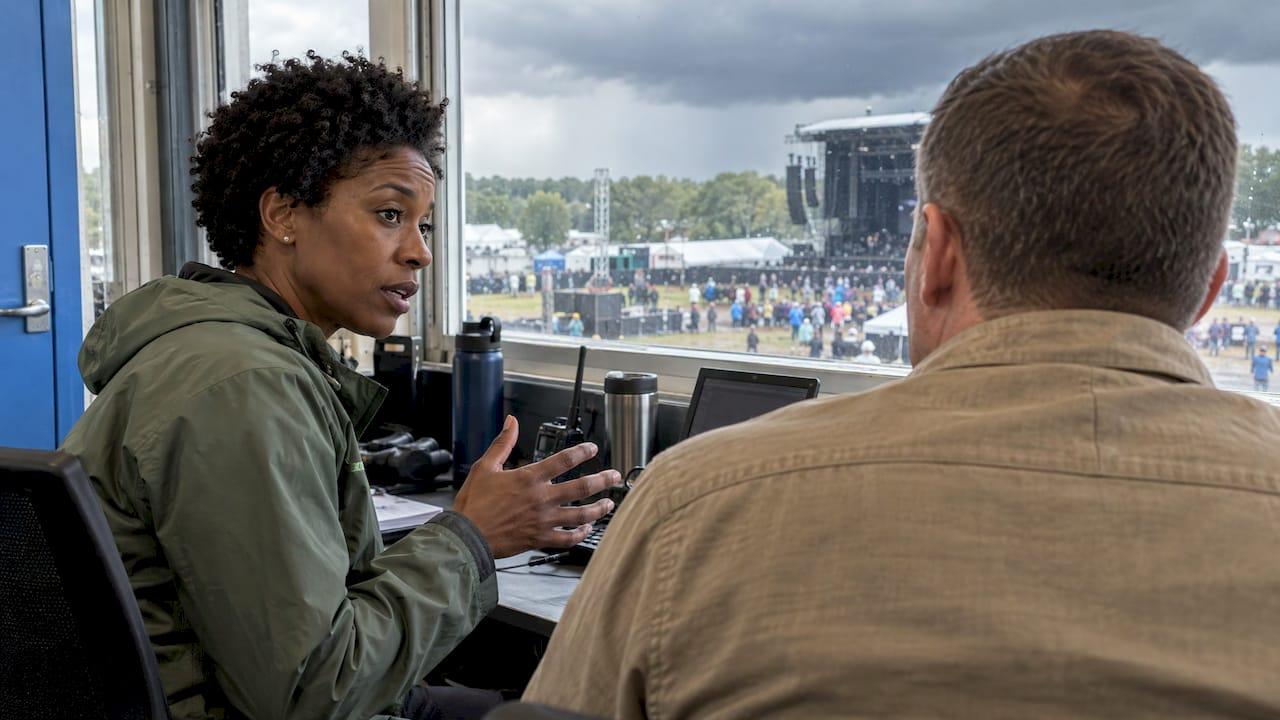
On-site meteorology services put a qualified meteorologist at your venue, plant or project site, so weather decisions are made by someone who is reading the sky, the radar and your operating plan at the same time. A phone app or a regional forecast describes the weather for an area. An on-site meteorologist tells you what it means for your stage, your crowd, your crane or your schedule, and when to act. At Wxprep, our certified consulting meteorologists (CCMs) provide customizable event forecasting and on-site support, with same-day analysis available when a decision cannot wait.
TL;DR
- On-site meteorology means a meteorologist embedded with your operation, translating radar, models and local observations into specific go, hold or stop decisions.
- The model is established in major outdoor sports: the PGA TOUR has reported that on-site meteorologists brief officials on storm location, movement, suspension timing and safe resumption.
- The value goes beyond stoppages: setup, site layout, staffing, logistics and maintenance can all be timed around the forecast.
- Look for a Certified Consulting Meteorologist, a written weather action plan agreed before the event, and a clear way to reach the forecaster on the day.
- The same expertise supports the record afterward: forensic reports and expert testimony for insurers and attorneys when weather becomes a claim or a dispute.
Table of Contents
- What on-site meteorology services actually are
- What an event meteorologist does before the event
- What happens during the event
- Weather decisions that are not stoppages
- Why local conditions change the answer
- Who needs on-site meteorology support
- From the field to the file: forensic reports and testimony
- How to choose an on-site meteorologist
- Our perspective
- Booking support from Wxprep
- FAQ
- Sources
What on-site meteorology services actually are
There are three things people confuse under this phrase, and the difference matters when you write a scope of work.
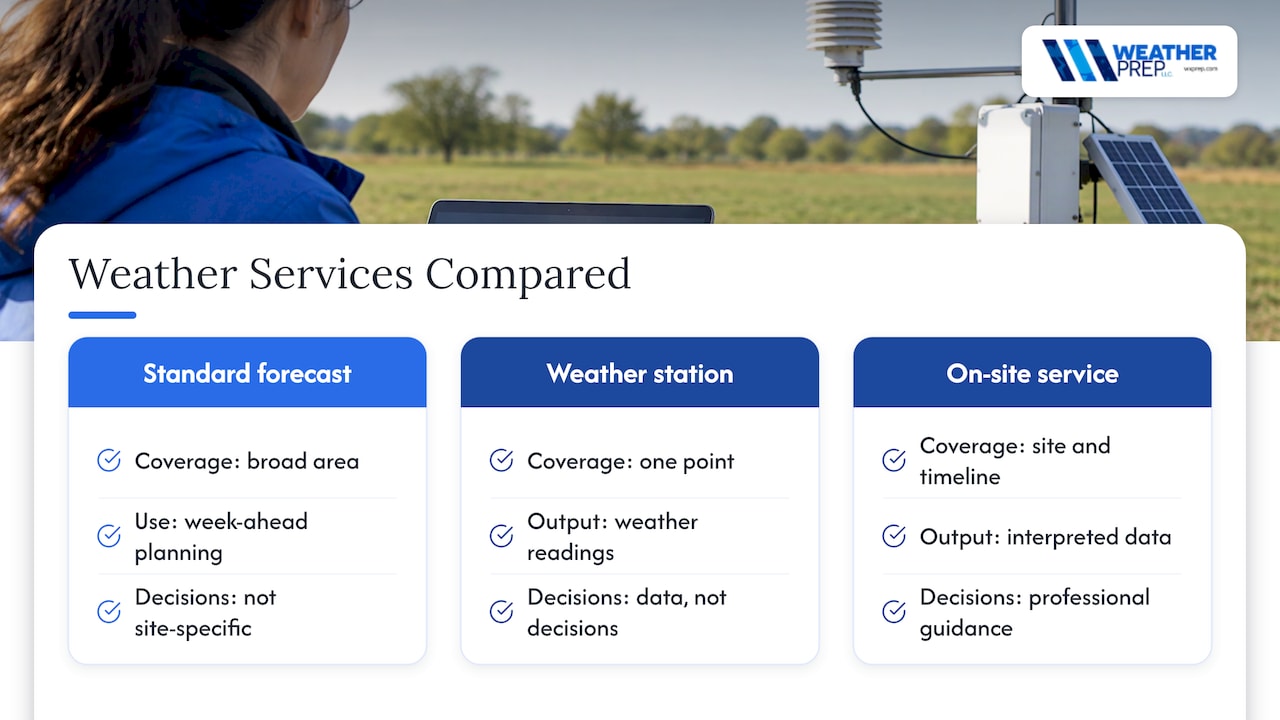
A standard forecast is a product built for a broad area. It is useful for planning a week ahead, but it cannot know where your tent anchors are, which lot floods, or how long your crew needs to clear a field.
An on-site weather station is an instrument. It records wind, rain, pressure, humidity and temperature at one point. It produces data, not decisions, and someone still has to interpret it.
On-site meteorology services are the people and the judgment: a forecaster who is present or in direct contact with your decision-makers, who knows your thresholds, and who interprets all the available data for your specific site and timeline.
Government agencies use the same logic. Environment Canada's mobile weather station, for instance, can be deployed within a few hours of an emergency and send initial data within an hour. Forecasters then use the readings to adapt forecasts to the site, including assessing plume trajectory, thermal inversions and mixing height. The measurement matters, but the adapted forecast is what responders act on. That is the model event and industrial clients buy: local information, interpreted by a professional, delivered in time to use.
What an event meteorologist does before the event
The most valuable work happens days before gates open. A meteorologist who joins planning early will typically cover the following.
- Climatology and risk profile. What is the realistic range of conditions for this site at this time of year, and which hazards (lightning, wind, heavy rain, heat, cold) actually threaten your format?
- Thresholds. The meteorologist and your safety lead agree on the conditions that trigger each action: pausing load-in, holding a stage show, clearing a seating area, delaying a start.
- Lead time per action. A threshold is only useful when it accounts for how long the action takes. If it takes 25 minutes to clear a grandstand, the decision point comes at least that long before the hazard arrives.
- A communication chain. Who receives the forecast, who can call a stoppage, and how the message reaches staff and the public.
- Daily briefings. Written or spoken updates in the days leading up, so there are no surprises on the day.
Our event weather planning guide walks organizers through this sequence in more detail. For one-off or recurring events, we tailor the forecasts and the plan to the event rather than handing over a generic product.
What happens during the event
On the day, the job is continuous monitoring and timely, plain-language calls. The clearest public example comes from golf. In a 2018 account, the PGA TOUR described how on-site meteorologists brief officials and help them judge where a storm is, how it is moving, when to suspend play and when it is safe to resume. The same account notes the tour has had a weather presence at tournaments since 1996, with its current provider since 2005. That is one sport's history, not an industry-wide date, but it shows how long organizers with real liability exposure have treated weather as an operational function.
The resumption call deserves attention. Stopping an event is usually easy to justify. Restarting is where organizers are tempted by a brightening sky while lightning or a second line of storms is still in range. A meteorologist who has watched the whole system evolve gives you a defensible, time-stamped basis for either decision.
For events with a crowd, the practical on-the-day deliverables are:
- Short, timed updates keyed to your thresholds, not raw radar loops.
- A direct line to the forecaster for quick questions from the operations lead.
- A clear recommendation at each decision point, with the reasoning behind it.
- A log of the forecast guidance and the times decisions were made.
That last item is more important than it appears, and we return to it below. For organizers working on a stoppage and shelter plan, general storm safety guidance on preparing buildings and power for severe weather is a useful companion to the meteorological side.
Weather decisions that are not stoppages
Most weather value is realized without anyone ever blowing a horn. The PGA TOUR's account shows this too: rainfall influenced hole placement, wind influenced tee placement, and forecasts shaped course maintenance. Translate that to other settings and the same pattern holds.
| Operation | Forecast-informed decision |
|---|---|
| Festival or concert | Timing of stage build, rigging and tent installation around wind windows |
| Outdoor sports event | Field or course setup, surface preparation, schedule order |
| Construction and logistics | Crane picks, concrete pours, deliveries and crew staging |
| Municipal or campus event | Staffing levels, shuttle and parking plans, cooling or warming stations |
| Emergency operations | Staging resources ahead of a storm, shift timing, recovery sequencing |
These are the decisions where a day of lead time saves real money. They also depend on a forecaster who understands your operation, which is why customizable service matters more than the length of the forecast.
Why local conditions change the answer
A regional forecast is an average over a wide area. Terrain, buildings, bodies of water and open lots all change what a site experiences. Wind can accelerate between structures, a shoreline can shift the timing of a front or sea breeze, and heat builds differently over pavement than over grass. A meteorologist working your specific site accounts for those effects, and, where observations are available from the venue, uses them to check and correct the forecast as the day goes on. Our real-time weather monitoring guide explains how live data is used in practice.
Who needs on-site meteorology support
Event organizers running outdoor festivals, races, tournaments, weddings with large guest counts or public gatherings, where a wrong call affects safety and revenue at once.
Businesses with exposed operations, such as logistics, construction, utilities and venues, where timing work around weather reduces delays and risk. Our risk mitigation work addresses the longer-term picture of extreme weather exposure.
Emergency management agencies, where weather consulting supports planning and live operations. We provide emergency plan support for these clients.
Insurers and legal professionals, who may never stand on a field but need the weather record that follows an event. For attorneys in New York and New Jersey and elsewhere, a meteorologist who has already documented the conditions in real time makes the later reconstruction faster and stronger.
From the field to the file: forensic reports and testimony
When weather causes a loss, an injury or a canceled contract, the question becomes what the weather actually was, at that place, at that time. Forensic meteorologists answer this from the record. As described in Physics Today, they gather government weather records, including surface observations, radar and satellite data, analyses and forecasts, along with eyewitness accounts. They evaluate the evidence, may run modeling or tests or visit the scene, and then write a clear report.
In property-insurance disputes, the same article explains that NEXRAD and Terminal Doppler Weather Radar data, together with surface observations, can help establish the timing, extent, duration and strength of an event, and whether damaging winds were straight-line or tornadic. That distinction can decide how a claim is classified.
For attorneys and adjusters, this is where on-site work and forensic work connect. A meteorologist who briefed an event in real time already understands the site and the sequence of conditions. Our guides to forensic meteorology services, hail damage analysis and the weather expert witness role cover what these engagements involve and when to retain a meteorologist, ideally before the weather record becomes difficult to reconstruct.
How to choose an on-site meteorologist
A short checklist serves most buyers.
Check the credential
The American Meteorological Society's Certified Consulting Meteorologist program was created, according to its program description, to assess technical competence, experience and character so users can select qualified consultants. The credential applies to individuals, not to companies, and it is not awarded simply for holding a degree. When you hire, ask who specifically will be on your site or on your phone and whether that person holds the certification. Our CCM guide explains what the credential means and when it matters most. Our consulting meteorologists are certified, which is central to how we work.
Define response time and coverage
Ask how quickly you will receive an analysis and how the forecaster will be reachable during the event. We offer same-day analysis and rapid turnaround for time-sensitive needs. Agree on the hours of coverage, the escalation path when conditions deteriorate, and the geography the forecaster will cover for your site or sites.
Ask what you will receive
A clear scope names the deliverables: pre-event briefings, thresholds, on-the-day updates, a decision log and, if wanted, a post-event summary. A good scope also states how uncertainty is communicated, for example as the likelihood of a hazard in a defined window rather than a single yes or no.
Plan the paper trail
If you are an organizer, insurer or counsel, keep the forecasts, the thresholds and the decision times together. If something goes wrong or a claim follows, a coherent record of what was known and when is far more useful than recollection.
Our perspective
Organizers rarely lose control of an event because they lacked a forecast. They lose it because nobody was responsible for turning the forecast into a decision with a clock on it.
That is the work of a consulting meteorologist. We believe the forecaster should understand your event, agree on your thresholds before the day, and be reachable when conditions change. Our certified consulting meteorologists work to go beyond raw data and explain what the weather means for your operation, and our same-day analysis is built for moments when waiting is not an option.
The same discipline carries into the claims world. When a weather event becomes an insurance question or a legal dispute, a record built on sound meteorological method holds up. We would rather help you prepare well than explain afterward what happened.
Michael
Booking support from Wxprep
We offer event forecasting, on-site meteorology support for events and logistics, risk mitigation, emergency plans, forensic reports and expert witness services, all customizable to the engagement. Review the full range on our services page, or start from our home page to describe your event, site or case.

If you already know your date and venue, send those details first: the forecaster can then begin with the risk profile and your decision thresholds. For general background on how we work with clients, see our overview of meteorological consulting services.
FAQ
What is the difference between an event meteorologist and a weather app?
An app delivers automated, area-wide forecasts. An event meteorologist interprets radar, models and local conditions for your specific site and timeline, then recommends actions against thresholds you agreed in advance. You get judgment, not just data, and a person you can question when conditions change.
When should I bring in a meteorologist for an event?
As early as the planning stage. Climatology, site risks and thresholds are set well ahead of the date, and daily briefings in the final week give you time to adjust setup, staffing and logistics. Late engagement is possible, and same-day analysis is available when a decision cannot wait.
Can the same meteorologist support a later insurance claim or lawsuit?
Weather records, radar and observations are the basis for forensic reports, and a meteorologist familiar with your site and the day's sequence is well placed to analyze them. Attorneys and insurers can also retain a meteorologist for a forensic report or expert witness testimony independent of any event.
What qualifications should I look for?
Look for a Certified Consulting Meteorologist. The American Meteorological Society's program evaluates technical competence, experience and character, and the certification belongs to the individual, so confirm who will actually be assigned to your engagement.
Sources
- Mobile weather station for environmental emergencies, Environment and Climate Change Canada
- Solving the weather issues on PGA TOUR, PGA TOUR, 2018
- The art and science of forensic meteorology, Physics Today, 2014
- Certification program for consulting meteorologists, American Meteorological Society, 1982