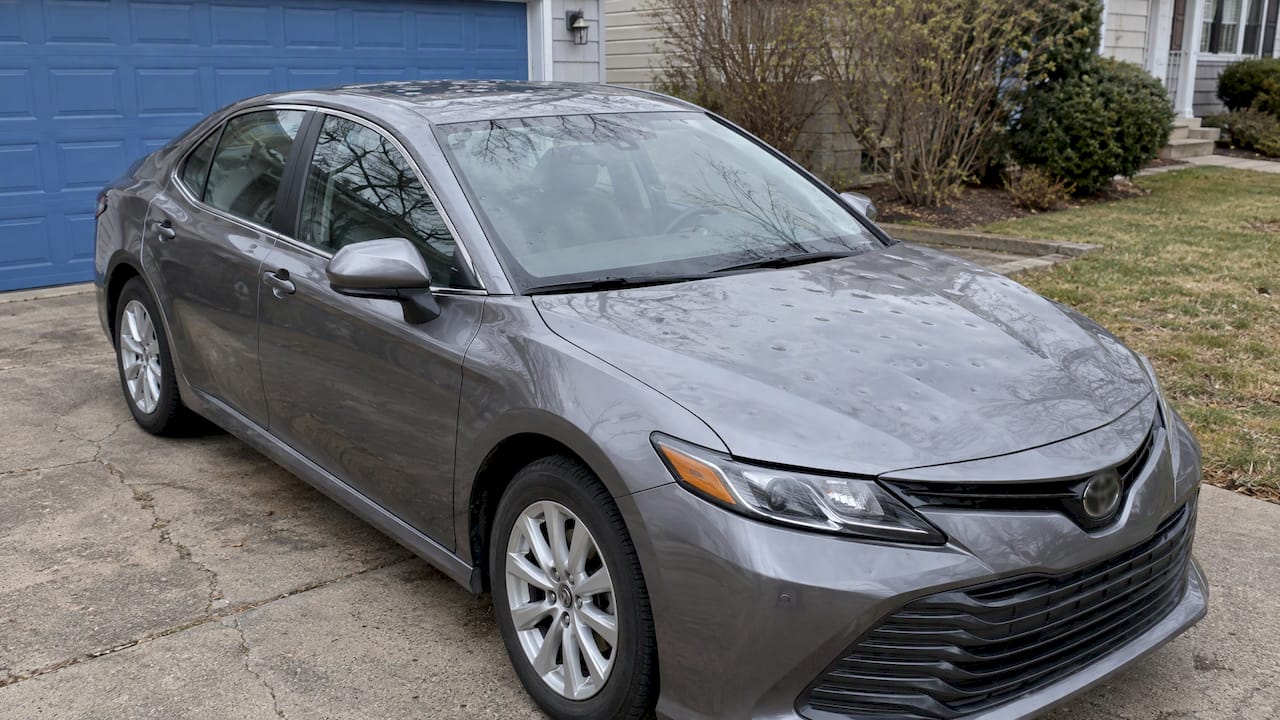
Hail damage analysis answers a question that a roof inspection cannot: did damaging hail actually fall on this property, on this date, at a size that could cause the damage in dispute? A certified consulting meteorologist answers it by reconstructing the storm from radar, surface observations, storm reports and damage evidence, then stating plainly what the data document and what is inference. At Wxprep, our forensic reports and same-day analysis are built for insurers, attorneys, businesses and event operators who need that answer in a form they can rely on.
TL;DR
- Hail damage analysis is a weather reconstruction: location, date and time, hail size and intensity, tied to a specific address.
- Radar estimates, storm reports and damage surveys each have known limits, so a sound report states what each can and cannot show.
- Hail of 1 inch or larger is the National Weather Service warning threshold, and shingle damage begins to appear around that size.
- The same method applies to freeze damage: the report documents when and where temperatures fell below freezing, and for how long.
- Insurers and lawyers use these reports to confirm or contest the date of loss and the cause of damage.
Table of Contents
- What hail damage analysis actually establishes
- The evidence a meteorologist works from
- How hail size connects to damage
- What radar, satellite and AI cannot prove
- Hail damage assessment for claims and disputes
- Freeze damage weather analysis
- What a defensible hail or freeze report contains
- Our perspective
- Getting a hail damage analysis from Wxprep
- FAQ
- Sources
What hail damage analysis actually establishes
A roofer or adjuster looks at the damage. A meteorologist looks at the storm. The two answer different questions, and disputes usually turn on the second one.
A hail damage analysis typically settles five things:
- Whether hail occurred at or near the property, and whether it was large enough to be damaging.
- When it occurred, to the day and often to the time window, which matters for policy periods and for separating one storm from another.
- How large the stones were, because size drives damage potential.
- How intense the event was, including how long it lasted and whether the core of the swath crossed the site.
- What else the weather did, such as accompanying wind, which can change how the damage should be read.
This is the same logic described in our guide to insurance weather verification: the weather record is the independent witness. It does not replace the inspection. It tells everyone which storm to blame, or that no qualifying storm occurred.
The question also matters to the people who model risk. NOAA's hail reference guide says hail data helps insurance professionals with risk assessment, catastrophe modeling and decision-making. Researchers working with Swiss insurance claims have shown that a storm's geographic footprint and the resulting building damage can be modeled together, which is the same footprint-to-damage thinking applied to a single property.
The evidence a meteorologist works from
Radar
Radar is the backbone of most hail reconstructions. NOAA's reference guide notes that dual-polarization radar, pioneered at the National Severe Storms Laboratory and now installed on National Weather Service radars across the country, can distinguish hail, ice pellets and rain and estimate hail size.
There is also a public archive built from it. NOAA's Event Footprint Catalog, updated in July 2026, tracks hail using radar estimates of near-surface hail size converted into merged swath shapes grouped by size, covering all 50 states, Puerto Rico, Guam and the Caribbean. For a claim in New York or New Jersey, that means a storm can be placed on a map and matched to a parcel.
Storm reports and warnings
Spotter and public hail reports, and the warnings the National Weather Service issued at the time, show what trained observers saw and what forecasters expected. They are ground truth where they exist, but they cluster where people are. A report from the next town is evidence, not proof about your roof.
Post-storm damage surveys
The National Weather Service also surveys damage after significant events. According to the NWS La Crosse office, a survey typically records the location, width, length and path of damage, the type and intensity of damage, the time it occurred, the cause and what people observed. Ground surveys allow interviews and a look at construction detail. Aerial surveys quickly establish location and path but lack ground-level detail.

Damage evidence itself
Bruising, spatter marks, dented soft metals and impacts on vehicles or equipment all help bracket stone size. A consulting meteorologist reads this alongside the radar, not instead of it. Where the two agree, the conclusion is strong. Where they differ, the report should say so.
How hail size connects to damage

Size is the first number everyone asks for, and the National Weather Service offers a useful benchmark. It issues Severe Thunderstorm Warnings when hail of 1 inch or larger is expected, a criterion that replaced 3/4 inch on January 5, 2010. The same page summarizes shingle testing: no damage at 3/4 inch, some damage to 11-year-old shingles at 1 inch, damage to nearly all shingle types at 1.25 inches, and golf-ball-size hail of 1.75 inches typically needed to dent cars.
These thresholds are guides, not guarantees. Roof age, material, pitch, the wind driving the stones and stone hardness all change the outcome. A worked example shows how this plays out:
A commercial property reports roof leaks and asks its insurer to cover hail damage. The meteorologist finds radar-estimated hail of about 1 inch crossing the site on one afternoon in May, and no larger hail at the site on any other date in the policy year. That places a plausible damaging event on a specific date. It does not by itself prove that this storm caused every leak, so the report states the documented hail size and timing and leaves causation to the engineers and the adjuster, unless the evidence supports a stronger statement.
That separation between what the weather record documents and what damage it implies is the center of a defensible report.
What radar, satellite and AI cannot prove
Every method has a limit, and the better the report, the more clearly it names them. Research on radar-derived hail estimates finds that reflectivity cannot separate hail size from hail concentration, stones drift horizontally as they fall, and radar says nothing about hail hardness, which strongly affects damage. The same study notes that insurance claim data are biased toward populated areas and record cost, not hail size.
The environment matters too. Work published in 2024 found that low humidity, high CAPE and CIN and weak winds aloft are associated with radar overestimating or underestimating hail size in predictable ways, which is why a meteorologist considers the atmospheric setting and not only the radar image.
How well can models do? A Swiss open-source model built on 250,000 damage reports estimated the correct order of magnitude for the number of damaged buildings in 91% of more than 100 large hail events, and for building cost in 77%, with remaining uncertainty largely attributed to radar detection limits. That is strong for portfolio-level work. For a single address, it is a reason to combine several lines of evidence.
Two more points belong in any careful assessment:
- Hail melts. A German study of more than 526,000 hail claims notes that hail melts and human reports are biased toward populated areas and roads, and that damage cannot always be assigned to the exact day. Of 1,830 possible days, 1,815 recorded at least one hail-damage occurrence, so date assignment needs independent evidence.
- Remote sensing is a screen. Drone photogrammetry with machine learning has detected 98% of synthetic hail objects and 81% of real hailstones in research settings, and may help close the gap between sparse ground sensors and area-wide radar. Our guide to satellite weather data covers what overhead observations measure and where they stop.
Hail damage assessment for claims and disputes
In practice, the analysis is requested at predictable moments.
Date of loss. Policies cover specific periods, and older hail can be mistaken for newer hail. A weather history for the address, covering the policy period and earlier years, shows which events qualify.
Scope and severity. When a roof or fleet of vehicles is damaged, the size and intensity at the site help show whether the damage is consistent with the storm.
Deductibles. Many policies carry separate percentage-based deductibles for wind and hail, so the cost of a claim depends heavily on how the event is classified. An independent agency explains how wind and hail deductibles can reach thousands of dollars, which is why the documented weather event often decides who pays what.
Litigation. When a claim is contested, the weather evidence has to survive cross-examination. Our overview of what a weather expert witness does in court explains how a reconstruction becomes testimony, and our page on forensic meteorology services describes when to bring in a meteorologist early.
Lawyers in New York and New Jersey, where hail, nor'easters and winter freezes all generate property claims, tend to need the same three things: a precise date, a defensible measure of intensity, and a clear line between documented fact and opinion.
Freeze damage weather analysis
The logic carries over to freezing conditions. Instead of hail size, the key facts are temperature, duration and timing: when did temperatures at the site fall below freezing, for how long, and did that match the reported loss?
A federal court order shows how decisive this can be. In a Texas insurance dispute, the policyholder claimed frozen pipes. The court noted that a weather report showed temperatures of 34 to 37°F on the reported loss date, that National Weather Service data showed Richmond-area temperatures of 35 to 76°F that week, and that Winter Storm Uri had not yet reached the area. The court found the damage resulted from rodents and long-term seepage. The weather record did not decide the whole case, but it removed the freeze explanation.
Freezing rain and ice storms add another layer. A review in the Journal of Applied Meteorology identifies the main data sources as long-term records of freezing-rain occurrence, 50-year records of insured property losses and estimates of ice loading on wires and structures. The authors also separate recorded observations from created ice-load values, and note that each has distinct strengths and limits that users must understand. A freeze report should do the same: label which numbers were measured and which were derived.
What a defensible hail or freeze report contains
Whether you are an adjuster, an attorney or a risk manager, you can judge a report against this list:
- The exact location and a defined window of dates. Coordinates or an address, and the period examined.
- Named data sources. Radar products, observation stations, storm reports and warnings, each identified.
- Hail size or temperature findings, with the method. Not just a number, but how it was derived and for which point or area.
- A history, not just one storm. Other events at the site that could explain the damage, including earlier years.
- A line between observation and inference. Documented weather conditions are stated as such, and any link to damage causation is framed as the meteorologist's opinion with its basis.
- Stated limitations. Radar resolution, hail melt, reporting gaps and the distance of the nearest observations.
- Credentials. A certified consulting meteorologist who can stand behind the work if the file becomes a dispute.
The list takes judgment at every step. Choosing which radar product fits the storm, deciding whether a nearby report is representative and phrasing a conclusion so it holds up under questioning are the parts that raw data does not do for you. That is where our certified consulting meteorologists work, and why we deliver analysis that goes beyond raw data.
Our perspective
Raw weather data is abundant and free. What is scarce is someone who can read it for one address, one date and one dispute, and then explain the result to an adjuster, a jury or a board.
That is how we approach hail and freeze work. Our certified consulting meteorologists build the reconstruction, say what the record documents, and keep the line between fact and opinion visible. Because we offer same-day analysis and customizable services with direct access to the meteorologist, you can ask questions while the file is still open instead of waiting for a static document.
The same applies when the question is not a past storm but a coming one. Event organizers, construction firms and emergency planners need the same discipline applied forward in time, and our severe weather planning guide shows how.
Michael
Getting a hail damage analysis from Wxprep
We provide forensic reports, expert witness work, risk mitigation reports, event forecasting and emergency management weather consulting, with rapid turnaround available. If you hold a claim file, a policy period or a trial date and need to know what the weather did at the property, start with our forensic reports or review the full range on our services page.

Bring the address, the date of loss you are testing and the policy period. Our meteorologists will tell you what the weather record can support.
FAQ
Is hail damage analysis the same as a roof inspection?
No. An inspection documents the condition of the roof. A hail damage analysis documents the storm: whether hail fell at the address, when, and how large. The two are used together, and the weather findings help show which storm the roof damage is consistent with.
How large does hail have to be to damage a roof?
The National Weather Service reports that shingle testing showed no damage at 3/4 inch, some damage to older shingles at 1 inch and damage to nearly all shingle types at 1.25 inches. Roof age, material and wind change those results, so a site-specific analysis is more reliable than a single threshold.
Can radar alone prove hail hit a specific building?
Radar gives a strong estimate of hail size and track, but it has known limits, including drift of stones as they fall and no measure of hardness. A sound analysis combines radar with storm reports, surface observations and damage evidence for the address.
Can weather analysis show whether freezing caused damage?
It can show whether and when temperatures at the site fell below freezing and for how long. In one federal case, temperature records for the loss date and the days around it did not support a freeze explanation. Weather data documents conditions, and whether those conditions caused the damage is a separate question the report should treat carefully.
Who uses hail damage weather analysis?
Insurers and adjusters use it to verify dates and severity, attorneys use it to support or challenge causation, and property owners and businesses use it to understand exposure. Event and logistics planners use the same methods to anticipate hail before it arrives.
Sources
- Hail Data Reference Guide, NOAA NCEI
- Event Footprint Catalog data sheet, NOAA NCEI
- Local damage assessment, NWS La Crosse
- Bayesian modeling of insurance claims for hail damage
- Radar and environment-based hail damage estimates, AMT (full paper)
- Radar and environment-based hail damage estimates, AMT
- An open-source radar-based hail damage model, NHESS
- Hail events in Germany, NHESS
- Performance assessment of drone-based hail measurement, Frontiers
- Sources of Data on Freezing Rain and Resulting Damages, AMS
- Federal court order, case 4:22-cv-02806, govinfo.gov
- Wind and hail deductibles for U.S. homeowners