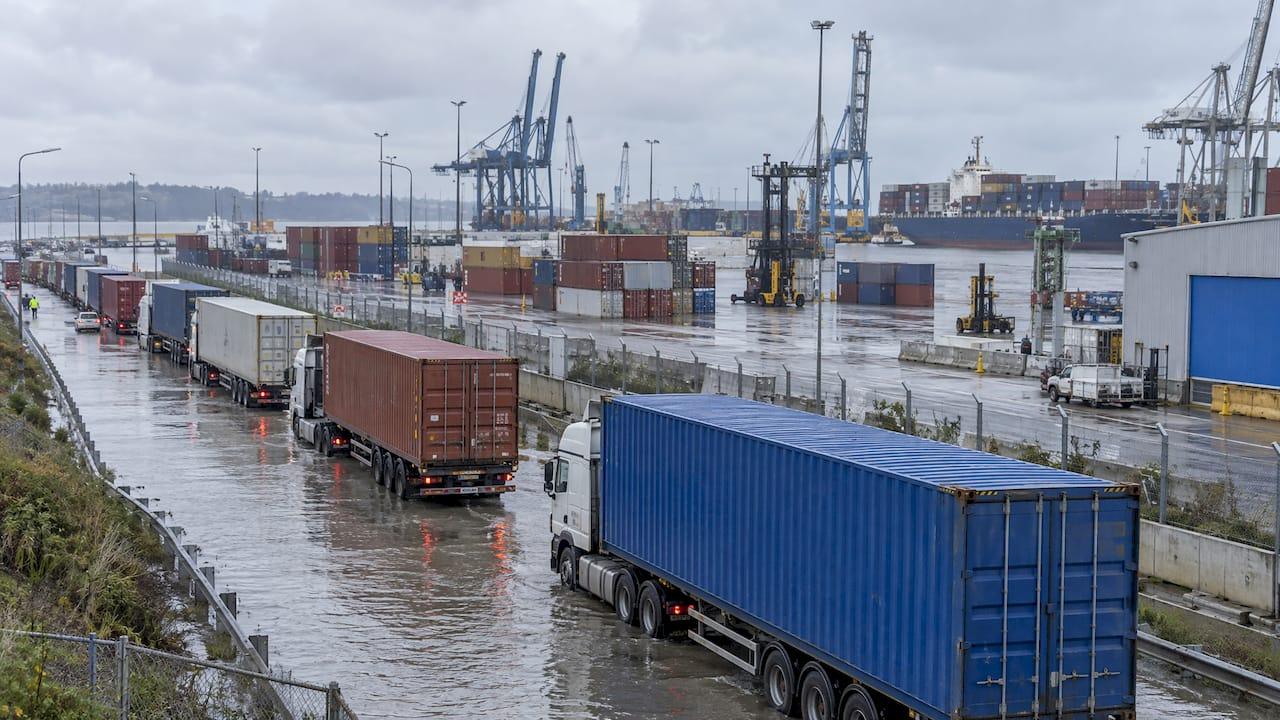
Weather disrupts supply chains at the weakest physical point: a flooded road, a closed port, a warped rail line, a low river. The businesses that absorb these shocks best treat weather as a quantified operating risk, with a site-specific forecast before the event and a documented, defensible weather record after it. That is the work of a consulting meteorologist, and it is what we do at Wxprep: certified consulting meteorologists (CCM) who provide same-day analysis, customizable to your lanes, facilities and events, and forensic reports when a loss has to be explained to an insurer or a court.
This guide is written for event organizers, logistics and operations leads, insurers and claims teams, and attorneys, including those practicing in New York and New Jersey. It explains how weather breaks supply chains, what the research says it costs, and where professional meteorological analysis changes the outcome.
TL;DR
- Weather rarely destroys a supply chain evenly. It breaks chokepoints first: local trucking, ports, warehouses, rail, and river and canal routes.
- Federal Reserve research found that weather shocks at supplier locations hurt both the supplier and its customers, and customers become more likely to drop suppliers when shocks exceed expectations.
- Flooding and hurricanes close ports for days, and the delays that follow depend on the roads and rail behind the port.
- Preparation means knowing which nodes are exposed, setting forecast-based triggers, and keeping a clear weather record for claims and disputes.
- Our certified consulting meteorologists deliver same-day analysis, forensic reports, expert witness testimony, risk mitigation reports and event forecasting.
Table of Contents
- How weather actually breaks a supply chain
- What the research says it costs
- Which operations are most exposed
- How to assess and prepare for weather risk in your supply chain
- Events and on-site logistics are supply chains too
- When the loss is already done: insurers and attorneys
- Perspective
- Work with a consulting meteorologist
- FAQ
- Sources
How weather actually breaks a supply chain
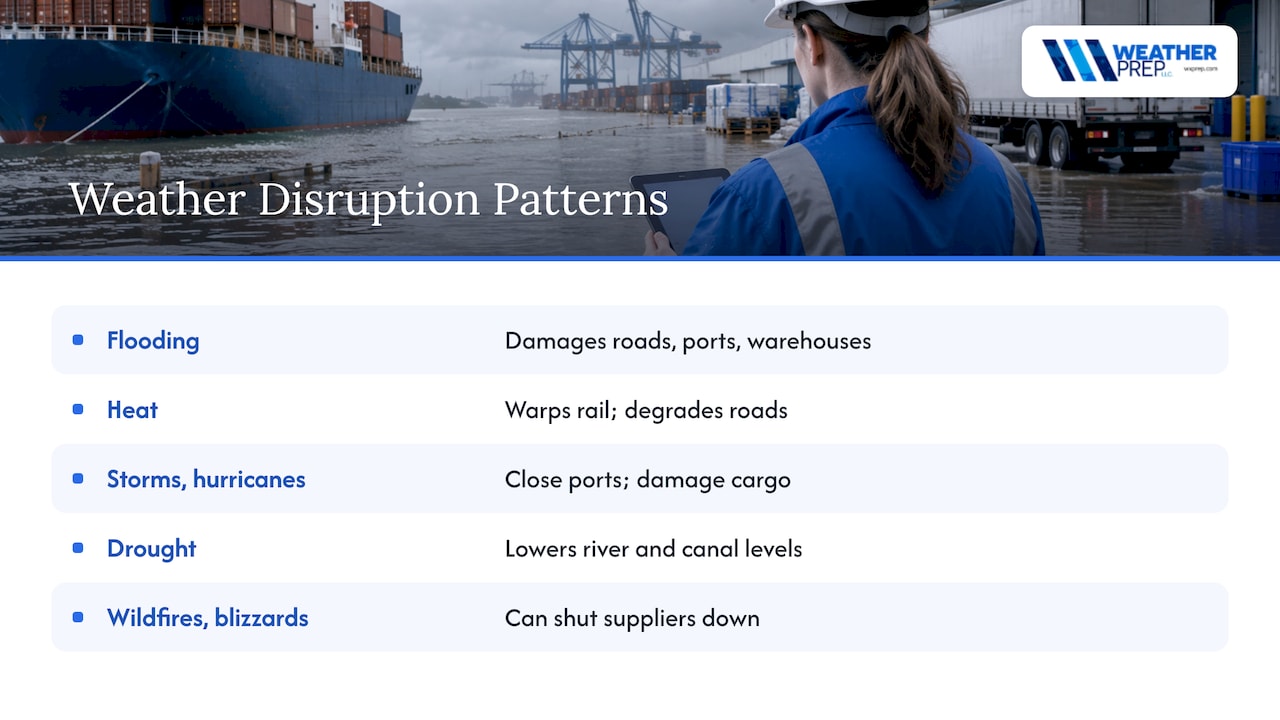
A supply chain is a series of physical handoffs: production, trucking, port or rail terminal, warehouse, last mile. Each handoff has its own weather tolerance, and a failure at one node spreads to the rest. Maersk's 2025 guide groups the damage into five patterns: flooding that damages roads, ports and warehouses; heat that warps rail and degrades roads; storms and hurricanes that close ports and damage cargo; drought that lowers river and canal levels; and localized shocks such as wildfires and blizzards that shut suppliers down.
The same source, along with the National Academies, describes the pattern after a hurricane in three mechanisms. Demand shifts as customers surge before and after a storm. Capacity falls as plants, power and workers are lost. Communications fail when power, cell and broadband service go down. When demand outruns what remains, lead times lengthen and shortages follow.
The first link to break is usually local
In a February 2026 interview, e2open's John Lash told Supply Chain 24/7 that local trucking and drayage tends to fail first, because it depends on roads, drivers and equipment all at once. Costs climb fastest where weather suddenly tightens capacity, for example when a polar vortex pushes freight into higher-priced spot markets, with temperature-controlled freight especially tight in the Northeast and Midwest.
The National Academies reached a similar conclusion from the 2017 hurricanes Harvey, Irma and Maria. In its post-hurricane supply chain study, bottlenecks appeared more often in distribution than in production: shortages of trucks and drivers, worker shortages and damaged infrastructure. For an operations manager, this means the factory or warehouse may be fine while the last 50 miles are not.
Ports and warehouses concentrate the risk
Ports and distribution centers are centralized chokepoints. Heavy weather slows or halts container moves, and when a storm hits a port and its linked warehouse at the same time, congestion compounds. For the New York and New Jersey region, where the port complex, rail yards and warehouse belts sit within a few miles of each other, one coastal storm can stress all three together.
What the research says it costs
Port closures and recovery time
The UNCTAD Resilient Maritime Logistics guidebook reports that about 38% of global container port activity sits in areas with high hurricane risk, including the U.S. Eastern Seaboard, coastal China, Japan and South Korea. Floods tend to affect ports longer than hurricanes, with an average of close to 11 affected days against 4.25 for hurricanes, and longer disruptions are tied to damaged road and rail links in the hinterland. The lesson is that the storm date is not the recovery date.
Production, rivers and canals
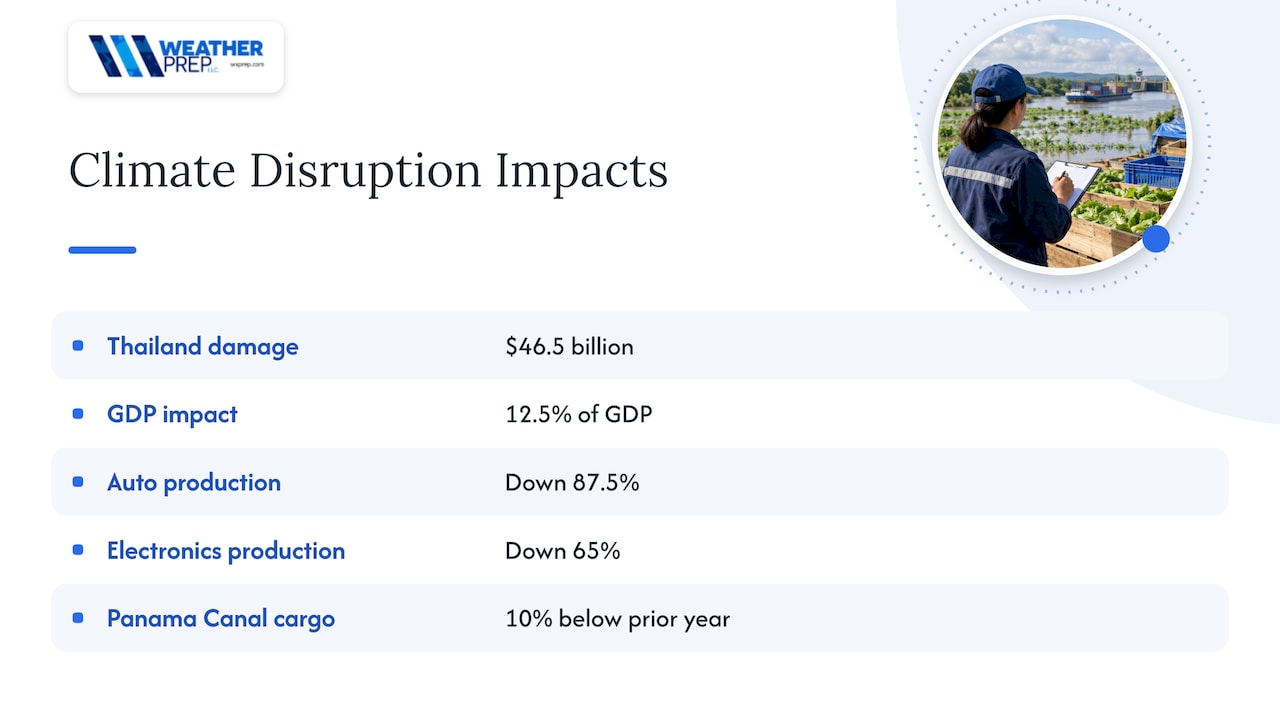
The Bruegel working paper on climate risks to global trade describes the 2011 Thailand floods: $46.5 billion in damage, equal to 12.5% of GDP, with automotive components production down 87.5% and electronics down 65%. The same paper notes that about 90% of traded goods move by sea and that Panama Canal cargo volumes in the fourth quarter of 2023 were 10% below the prior year because drought restricted transits. For a practical look at how low water changes freight routing and cost, see this overview of Panama Canal drought and shipping.
Inland waterways are just as sensitive. McKinsey's analysis, Could climate become the weak link in your supply chain?, reports that in the third quarter of 2018 Rhine transport fell 27% year on year because of drought, and that on the upper Mississippi a one-inch drop in river level can cut a typical tow's capacity by 255 tons. A peer-reviewed study in Risk Analysis found that the 2022 to 2023 heat and drought produced a 400% surge in barge rates.
Relationships, revenue and profit
Two Federal Reserve studies show the financial mechanism. Pankratz and Schiller found in their Federal Reserve paper that weather shocks at supplier locations reduce the operating performance of suppliers and their customers, and that when realized shocks exceed expectations, customers are 6 to 11% more likely to end the relationship. A New York Fed staff report, using import data across more than 40,000 maritime routes, found that unexpected weather-induced shipping delays significantly reduce importers' revenues, profits and employment.
The word that matters in both studies is unexpected. Delays that were forecast, planned for and priced in cost less than delays that arrive as a surprise.
Recent examples
Aon's April 2025 report cites Hurricane Helene as the costliest U.S. event of 2024, with an estimated $78.7 billion in direct damage, and notes that U.S. hurricanes in 2024 caused major railroad business-interruption losses, with a mile of replacement track costing $1 million to $2 million. It also records wildfire deductibles for rail clients reaching $100 million, up from $25 million. Those numbers matter to insurers and risk managers because they show how quickly a weather event becomes a coverage question.
Which operations are most exposed
Exposure depends on what you move and where. The Aon report points to rail, which relies on a small number of global component suppliers, agriculture and luxury crops such as coffee and cocoa, and automotive manufacturing, where Spain's 2024 floods disrupted production. Key crop yields have fallen about 5% on average because of climate volatility, according to the same report.
Some patterns repeat across industries:
| Weather hazard | Where it bites | Typical consequence |
|---|---|---|
| Flooding | Roads, ports, warehouses, rail links | Closures, damaged cargo, long hinterland delays |
| Extreme heat | Rail, port cranes, aircraft loads, vehicles | Speed restrictions, suspended crane work, weight limits |
| Hurricanes and coastal storms | Ports, power, communications | Terminal closures, demand spikes, worker shortages |
| Drought | Rivers and canals | Reduced cargo capacity, rerouting |
| Snow and ice | Highways and passes | Cancelled shipments, spot-market rate spikes |
The heat effects come from the Kühne Climate Center's Logistics in a +2°C world report, which also explains that for shippers, disruption becomes stockouts, production shutdowns and lost sales.
How to assess and prepare for weather risk in your supply chain
The research points to the same preparation habits. Here is the routine, with the points where meteorological expertise changes the result.
1. Map the nodes that weather can stop
List every supplier, route, port, warehouse and event site that your delivery depends on, then note the hazard each one faces: coastal surge, river flooding, heat, snow, lightning, wind. The National Academies found that limited pre-storm assessment of vulnerable nodes left emergency managers unable to see bottlenecks and prioritize relief. Our risk mitigation reports are built for this step: a climate and weather risk assessment of your specific facilities and lanes, rather than a regional average.
2. Quantify the exposure
Aon recommends using catastrophe and climate models to estimate value at risk under different scenarios, and mapping visibility beyond your first-tier suppliers, so a single-node failure does not cascade. The step fails when the hazard data is generic. A consulting meteorologist translates a wind, rainfall or surge threshold into what it means for your dock, your yard or your truck routing.
3. Set forecast-based triggers
A trigger is a pre-agreed forecast condition that starts an action: rerouting freight, moving inventory, holding a shipment, or evacuating a site. Triggers fail when nobody owns the call. For a worked method, see our guides on severe weather response planning and weather contingency planning. In the hours before an event, our same-day analysis gives your team a forecast read tied to your thresholds, with direct access to a certified meteorologist rather than a generic alert feed.
4. Build buffers and alternatives
Manufacturing Dive reported in November 2026 that a Sonoco industry report advises keeping a standing forecast and demand-planning conversation with key suppliers, and positioning safety stock to absorb a four- to six-week transportation delay ahead of a severe El Niño. APM Terminals' Brian Harold ties resilience to multiple pathways to move cargo. Walmart showed the idea in practice in March 2024, when a Nevada snowstorm closed a major pass: it used predictive analytics to identify 85 alternative stores and four distribution centers to reroute deliveries, as the Kühne Climate Center report describes.
5. Plan for power and communications
The National Academies found that recovery speed depends heavily on the resilience of power and communications, and that large companies with continuity plans and hardened systems fared better than small ones. Our emergency plan work covers weather-driven continuity for organizations that need a documented response. For hurricane-exposed operations, this hurricane business preparedness guide shows how a plan begins with the forecast.
6. Keep the weather record
When a delay becomes a claim, the question is what the weather actually was at that place and time. Official station data is often miles from the site, and conditions can differ block to block. A forensic weather report reconstructs the event at your location. Our guide on how meteorologists reconstruct a storm explains the method, and our construction-focused piece on weather delays, claims and prevention shows how the same record decides who bears the cost.
Events and on-site logistics are supply chains too
A festival, a trade show or a concert tour is a time-boxed supply chain: stages, generators, catering, vendors, security and attendees all arrive on a schedule that weather can break. Wind loads on temporary structures, lightning, heat and flooding on a load-in route are the usual failure points. Our event forecasting service is tailored to your site and timeline, and we support events with on-site meteorology so decisions are made with a meteorologist at your side. Useful starting points are event weather planning, festival weather forecasting and lightning risk management. For a broader framework, read our practical guide to severe weather planning.
When the loss is already done: insurers and attorneys
After a disruption, three questions drive claims and litigation: how severe the weather was, whether it was foreseeable, and whether it caused the loss. Insurers need forensic weather reports to verify that a covered event occurred at the insured location. Attorneys need a qualified witness who can explain the meteorology to a judge or jury. For lawyers in New York and New Jersey, where coastal storms, nor'easters, flash flooding and winter events are routine causes of loss, that means site-specific data, a clear method and a certified meteorologist able to testify to it. Our forensic reports and expert witness services are built for that purpose.
Perspective
Every disruption study we read says the same thing in different words: the damage grows with surprise. A port closing for four days is a manageable cost when you saw it coming on Monday. It is a crisis when you learn about it from your carrier on Thursday.
That is why we think of weather as an operating input, not a headline. A forecast is only useful when it is tied to a decision: hold the shipment, move the crew, delay the load-in, cancel the outdoor stage. Our job as certified consulting meteorologists is to take the raw data and tell you what it means for your operation, and to do it the same day, when the choice is still open.
Afterward, the same discipline serves the other side of the table. A forensic report that reconstructs what the atmosphere did at your exact location gives insurers and attorneys a record they can rely on, and expert testimony that stands up to scrutiny.
The organizations that fare best are the ones that bring a meteorologist in before the storm, not after it.
Michael
Work with a consulting meteorologist
Whether you need a forecast for a high-stakes event, a risk mitigation report for your logistics network, or a forensic report and testimony for a claim, our team provides same-day analysis with direct access to a certified consulting meteorologist. See the full range of Wxprep consulting services, or start a forensic matter through our forensic reports page.

FAQ
What weather event causes the longest supply chain delays?
UNCTAD's data shows floods affect ports longer than hurricanes on average, close to 11 days against 4.25, mostly because road and rail links behind the port stay damaged. Droughts can also last for months by reducing river and canal capacity. The length of a delay depends on the whole route, not just the point where the weather hit.
Which part of the supply chain breaks first in extreme weather?
Local trucking and drayage is typically first, because it depends on roads, drivers and equipment at the same time, according to the 2026 Supply Chain 24/7 interview with e2open's John Lash. Ports and warehouses follow, especially when one storm hits both. Distribution bottlenecks were also more common than production bottlenecks after the 2017 hurricanes.
Can a forecast really reduce supply chain losses?
Research from the New York Fed ties losses to unexpected weather-induced delays, which implies that anticipated delays cost less. A forecast tied to triggers lets you reroute, stage inventory or reschedule before the disruption arrives. Our certified meteorologists provide same-day analysis for that purpose.
When do I need a forensic weather report instead of a forecast?
You need one when a loss or delay has already happened and someone must prove what the weather was at a specific place and time, usually for an insurance claim or a legal dispute. A forensic report reconstructs the event at the site, and our meteorologists can also provide expert witness testimony if the matter goes to court.
Sources
- How does severe weather disrupt supply chains? (Maersk)
- Strengthening Post-Hurricane Supply Chain Resilience (National Academies)
- Prepare Your Supply Chain Now for the Next Extreme Weather (Supply Chain 24/7)
- 1.2 Extreme Weather Events (UNCTAD)
- Climate Risks to Global Trade (Bruegel)
- Panama Canal Drought and Shipping
- Could climate become the weak link in your supply chain? (McKinsey)
- Regional supply-chain impacts of Mississippi River disruptions (Risk Analysis)
- Climate Change and Adaptation in Global Supply-Chain Networks (Federal Reserve)
- Input Sourcing Under Supply Chain Risk (New York Fed)
- Steering Trade and Supply Chains Amid Weather Challenges (Aon)
- Logistics in a +2°C world (Kühne Climate Center)
- How to prepare for the most severe El Niño on record (Manufacturing Dive)